
By Harold D. Stolovitch
hstolovitch@hsa-lps.com
 Sometimes
a pre-prepared, content-set seminar, complete with perfectly stated objectives
just doesn't cut it. Occasionally, what is needed is to spend a few hours
or even a whole day delving into questions, issues, curiosities and concerns
about a specific topical area generated by the participants themselves.
That's what the Potpourri session (a miscellaneous mixture of things)
is all about.
Sometimes
a pre-prepared, content-set seminar, complete with perfectly stated objectives
just doesn't cut it. Occasionally, what is needed is to spend a few hours
or even a whole day delving into questions, issues, curiosities and concerns
about a specific topical area generated by the participants themselves.
That's what the Potpourri session (a miscellaneous mixture of things)
is all about.
In the example I provide, I've applied it to the broad field of instructional systems design (ISD). However, as will soon become apparent, you can employ the same potpourri pattern with any content, set of issues or discipline from abstract art, baseball and calligraphy to xenogenisis, Yiddish and zither music. Basically, the purpose of the Potpourri session is to share ideas, explore themes and acquire new insights about a range of topics related to a general area of interest. It is an opportunity for participants to explore, with the help of an expert in the subject-matter area, themes that are of specific interest to them.
Some of the solid characteristics of this type of session are: it quickly engages participants who are pre-sensitized; offers opportunities to delve into topics that are often ignored; allows the leader-facilitator to provide a broad assortment of documentation that, because of the session, acquires heightened significance for the participants.
How does it work?
Let's use the ISD example as our theme. Prior to the Potpourri session,
the leader sends out a list of topics from A to Z to trigger suggestions
(see below).
|
Sample List of ISD Related Topics
|
The list is only an opener - a teaser menu - to stimulate questions and provoke reflection. Participants can either select from the menu offerings or generate their own items. Once these are chosen - and every participant must select or request at least one item - they are sent back to the leader, who sorts them, pulls themes together and, if necessary, sends out the list of choices for rank ordering. This is done when too many items are requested for the time allotted. Incidentally, having designed and delivered this type of session numerous times, I have rarely had to initiate a second round. The reason: because often I have been able to discover some brief, useful materials or resources dealing with proposed outlying items and have simply included them for rapid treatment in the Potpourri package of materials.
Now, for the major work. Once the Potpourri list of items has been created, the leader has two main tasks. The first is to research and pull together a collage of information and materials, based on the items, to share with the group. The second is to design an activity dealing with each item or theme. The following table shows three items and activities for a Potpourri on ISD.
|
Sample Selected Items and Activities for an ISD-Related Potpourri |
|
|
Selected
Items
|
Activities
|
|
|
|
|
|
|
Running the session itself is a lot of fun since it is created based on what the participants themselves have selected. You start the session with the establishment of an agenda and the setting of priorities. Then, in a fast-paced and interactive mode, everyone becomes involved.
Participants leave with a plethora of materials, resources, new knowledge and often some newly acquired skills. You can build into the Potpourri session mini and micro workshops, team activities, spontaneous testing of concepts, principles and procedures and, of course, plenty of lively discussion. Participants also leave with a firmer grasp on many aspects of a topic or field about which they were initially unaware.
Instructional designers are always hunting for stimulating strategies that help learner-participants acquire a lot of knowledge and skills in a short time frame. The Potpourri session is definitely an instructional framework that mixes high effectiveness with efficiency. It is fun and not too difficult to create. It requires all participants to make an investment up front. It focuses on participant driven items. Best of all, it works!

By Erica J. Keeps & Harold D. Stolovitch
ekeeps@hsa-lps.com & hstolovitch@hsa-lps.com
 It's
fairly common to have one of your clients - internal or external - come
to you and say, "I've got a training problem. My [fill in with the
name of any group] is/are not getting the right results. They…[story
continues about the client's woes]. So I need you to give them training
on…[list of specifics]."
It's
fairly common to have one of your clients - internal or external - come
to you and say, "I've got a training problem. My [fill in with the
name of any group] is/are not getting the right results. They…[story
continues about the client's woes]. So I need you to give them training
on…[list of specifics]."
With infinite variations we encounter this type of request over and over again. Let's stop for a moment to analyze the scenario. Begin with the first sentence: "I've got a training problem." What's wrong with it? Select your answer.
The correct
answer is a very loud and clear number 3. The statement "I've got
a training problem," is akin to saying I have an aspirin problem.
Training, like aspirin, is a prescribed solution. There is a leap of faith
in that sentence that presupposes a training intervention, even though
it may not be appropriate or sufficient to achieve desired performance
results. Remember: training ain't performance!
This leads us to our performance improvement mantra: "cause-conscious, not solution-focused." Meditate for a moment. Visualize the scene. Your customer is right in front of you, pouring out her trials and tribulations. The more she speaks, the more convinced and committed she becomes about her needed training intervention. Yet, research on workplace performance tells us that training only works where there are skill and/or knowledge deficiencies. Many other factors affect performance. These may include anything and everything from the state of the economy to poor supervision to lack of access to equipment to "just-don't-care" attitudes, with an imposing array of other possibilities to be considered.
Still meditating, take a deep breath as your customer continues her explanation, and think, "cause-conscious, not solution-focused…cause-conscious, not solution-focused." Now keep on listening to the customer for clues to where the true problem might be. Practice with the following scenarios. In each case, select what you think might potentially be the real cause.
- "My people need training on selling skills. They don't seem to be able to position our new product against the competition." (They lack selling skills./The company hasn't defined the product's market position clearly.)
- "This is a real training problem. My customer service agents keep cutting the customers off in their explanations. They don't take enough time to listen." (They lack training in listening skills./They are measured on how many calls they handle and how quickly they handle them.)
- "This is a training issue. Even though they are technically savvy, our systems engineers don't check out every facet of the installations. We're experiencing a high volume of customer callbacks and increased customer dissatisfaction." (They lack technical skills and knowledge./They lack appropriate work standards and job aids.)
You didn't receive enough information in each case to make a clear diagnosis, but we suspect that you looked beyond the customer "training" request and at least considered the other possible cause in each case. This is what we mean by being cause-conscious, not solution-focused - not just accepting the first, most obvious and superficial intervention, but immediately adopting an analytical frame of mind that will ultimately lead to desired customer and organizational benefits.
Meanwhile, you have to move out of the meditation mode and respond in a helpful, supportive manner to your client. And here are your words: "I can help you solve your problem."
With your simple sentence (which we learned from Joe Harless, one of the top performance consulting experts), you have set your client at ease; offered support in a friendly, helpful manner; set the stage to delve into the true issues affecting performance and fulfilled the requirements of your mantra: cause-conscious, not solution-focused. Bravo!
This article is an excerpt from Harold Stolovitch and Erica Keeps' award-winning
book, Training Ain't Performance. Interested in learning more about
the new performance improvement mantra? Click here
to order a copy of the book.

 On
April 14, 2005, at the International
On
April 14, 2005, at the International  Society
for Performance Improvement's (ISPI) annual conference in Vancouver, BC,
Harold and Erica received ISPI's Outstanding Instructional Communications
Award for Training Ain't Performance.
The ISPI Award of Excellence designation recognizes significant contributions
to the profession. This award is considered the most prestigious award
in the field of Human Performance Technology publication. To learn more
about the book or to purchase a copy, click here.
Society
for Performance Improvement's (ISPI) annual conference in Vancouver, BC,
Harold and Erica received ISPI's Outstanding Instructional Communications
Award for Training Ain't Performance.
The ISPI Award of Excellence designation recognizes significant contributions
to the profession. This award is considered the most prestigious award
in the field of Human Performance Technology publication. To learn more
about the book or to purchase a copy, click here.

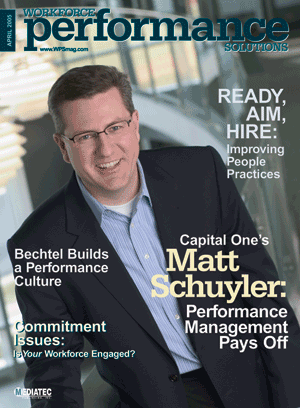 Workforce
Performance Solutions is
a new bi-monthly magazine. It is directed to top-level management, senior
human resources, and workforce and organizational development executives
whose task is to optimize the abilities of their human assets to drive
and improve the execution of enterprise strategy. This new magazine will
feature Harold Stolovitch as a regular contributor with a column entitled
"Human Performance." Workforce Performance Solutions
combines thought leadership and proven best practices to help human resources
executives and other business leaders create, deliver, manage and measure
human capital development initiatives that advance the enterprise through
all business climates.
Workforce
Performance Solutions is
a new bi-monthly magazine. It is directed to top-level management, senior
human resources, and workforce and organizational development executives
whose task is to optimize the abilities of their human assets to drive
and improve the execution of enterprise strategy. This new magazine will
feature Harold Stolovitch as a regular contributor with a column entitled
"Human Performance." Workforce Performance Solutions
combines thought leadership and proven best practices to help human resources
executives and other business leaders create, deliver, manage and measure
human capital development initiatives that advance the enterprise through
all business climates.
Click here and then click on the title to read Harold's entire first column, "Human Performance at Work." For more information on Workplace Performance Solutions, visit their Website at www.wpsmag.com. You may qualify for a free issue or subscription. If you have suggestions for Harold to include in his column, please email him at hstolovitch@hsa-lps.com.

The American Society of Training & Development (ASTD) featured Erica Keeps in the March 2005 T+D Extra Spotlight. Here is her interview.
 T+D
EXTRA: What do you think are the biggest challenges facing trainers?
T+D
EXTRA: What do you think are the biggest challenges facing trainers?
KEEPS: From my perspective there are two major challenges. The first is doing what's right versus doing what's hot. The other is about giving clients what they require, which isn't always what they request. With respect to the first one, time and time again we see trainers mesmerized by the latest, like technology-based training. Just because it's less sexy doesn't mean that it isn't the most effective and efficient approach.
Also, we see trainers stuck taking orders when they should be determining what the order is. Clients ask for training because that's what they think is required and because that's our title or the title of our department. Trainers need to shape their clients to better understand performance issues and the contribution "training" can make as well as what else may be needed.
T+D EXTRA: What, in your opinion, is the most important skill or competency for a new trainer?
KEEPS: For the instructional designer, I believe analysis skills (as in front-end analysis, task analysis, and learner analysis) are key. Instructors should focus more on the participant than on the content. They need to be a guide on the side, not a sage on the stage. Trainers often get in the way of learning!
T+D EXTRA: What was your most rewarding experience as a training director?
Without question, transitioning my organization from a traditional training department to a performance improvement function. That rewarding experience took place in the late 1970s before performance orientation was "cool."
Copyright © March
2005 T&D Extra by Josephine Rossi. Reprinted with permission
of American Society for Training & Development.

From time to time, we come across interesting articles that we feel are important to share with others. Our Guest Author Series features these articles by various professional colleagues. The fifth in our series is by Suzanne Saxe, President and co-founder of Advance Consulting, Inc. Suzanne's proven ability to engage an audience - interact with them and stimulate thinking culminates from over 20 years of experience in the fields of organizational development, training, and facilitation. She is co-author of the book, The Consultative Approach: Partnering for Results! and has advised numerous prestigious companies. Suzanne resides in Tiburon, CA and may be reached by email at suzanne_saxe@advanceconsulting.com.
7 Easy Steps to Building Client Relationships
By Suzanne Saxe
Our changing economy demands that today's companies deliver top-notch customer service to get our client's business. It's not just a quality product that lands the deal anymore. Today you need to understand your client's issues, speak their language and build relationships that get clients in the door and keep them coming back for more. But how? Below are seven easy steps that can help you build successful client relationships and boost your chances for positive results every time.
- Exude
Positive Confidence - Look for ways to focus on positive
outcomes with your clients and team members. Give positive feedback
before suggestions for improvement. Frame problems with a focus on solutions.
With a genuinely excited, self-assured attitude, you will start to attract
different people and achieve better responses from your clients.
- Develop
Rapport and Intimacy with Your Client -
Rapport is the ability to make others feel comfortable with you. Every
interaction you have with the client is an opportunity to build rapport.
Creating intimacy with your clients means taking the next step toward
a more honest relationship. It requires some caution, some courage,
and the willingness to be vulnerable as well.
- Promote and Maintain Trust - Trust is a warm, comfortable, embracing feeling. There are building blocks to developing and keeping trust. Focus on these building blocks to help you develop those successful client relationships:
- Credibility - This includes experience, expertise, insights, and how these qualities are communicated.
- Reliability - Do what you say you are going to do. Clients should be able to depend on you 100% and trust that you will follow through as discussed (or assumed).
- Responsiveness - Clients feel that they are paying for a certain level of responsiveness. For example, do they expect a phone call to be returned in 1 hour, 24 hours, or 3 days? Since everyone has a different need, it is important to understand your clients' expectations.
- Develop
Open and Complete Communication - It's important to be open
and complete in your communication with the goal of making the relationship
the best it can be. This involves being courageous and open enough to
state what you are thinking and being open to the response.
- Be
Service Oriented - Are your policies, procedures and processes
customer-oriented? Do they keep the client in mind? At least once a
year, examine your processes, policies, and ways of interacting with
clients and rate them on a scale as client friendly (+), neutral (0),
or internally focused (-). For all those processes, procedures, and
policies that are internally focused or neutral, think of ways that
you could make them client-friendly while still meeting your needs.
- Produce
the Desired Results - Clients engage us to help them get
results. Get specifics from your clients. Ask them, "What does
success look like?" How can you help them measure the results?
How can you help them sustain results and even get additional value?
If you truly understand what success looks like, you will have a much
better chance of helping your client win and get the desired results.
- Be Passionate and Fun - How passionate are you when you are with your clients? Are you upbeat and excited about working with them or do you carry the worries of the world on your shoulders? This principle cycles back to your attitude, but with a twist. When you are passionate and fun you are usually willing to share, collaborate, break through with new ideas, and provide the best your have to offer.
If, over time, some of these steps have gotten rusty or been forgotten, it's time to shine them up again! Now is the time to put them into action and enjoy the results.
Do you have an article you would like us to consider including in our Guest Author Series? If so, please contact Erica Keeps at ekeeps@hsa-lps.com.

 Harold
Stolovitch will be presenting at the 2005 Training Director's Forum in
Phoenix, AZ from May 21 - 23. Click here
to view HSA's Events Calendar to learn where and when Harold will be speaking
as well as to read session descriptions.
Harold
Stolovitch will be presenting at the 2005 Training Director's Forum in
Phoenix, AZ from May 21 - 23. Click here
to view HSA's Events Calendar to learn where and when Harold will be speaking
as well as to read session descriptions.
Due to popular demand, two ASTD Telling Ain't Training Conference locations have been added for 2005. Harold will be presenting at both. The first is from April 28 - 29 in Arlington, VA and the second is from October 20 - 21 in Atlanta, GA. For more information, click here. Can't make either conference? Click here to buy the best-selling, award-winning book.

 Do
you have any burning human performance technology questions? Visit the
Ask Harold section of HSA's Website
and ask your questions for Harold Stolovitch to answer. Here is a recent
submission that might intrigue you:
Do
you have any burning human performance technology questions? Visit the
Ask Harold section of HSA's Website
and ask your questions for Harold Stolovitch to answer. Here is a recent
submission that might intrigue you:
At the ISPI Conference in Chicago this past fall, you stated that learning styles are pretty much discredited now as they only account for 2% of learning effectiveness. You said there was no firm evidence to support them. Can you give more information on any academic literature to back up what you're saying? I agree with you but have colleagues who strongly disagree.
To read the response, visit Ask Harold. To ask your own question, just click on the crystal ball above, fill out the form and click submit.

Click on any of the covers below for more information or to buy copies of our books.




For more information on HSA, visit our Website
at www.hsa-lps.com, email us at info@hsa-lps.com
or call us toll free at (888) 834-9928.If you have any questions or comments, please feel free to contact Samantha Greenhill, Publications and Communications Specialist, at sgreenhill@hsa-lps.com.

To unsubscribe from this Newswire, please reply to this email and put the word UNSUBSCRIBE in the subject line.
© Copyright 2005 Harold D. Stolovitch & Erica J. Keeps