You
can access HSA's Website at www.hsa-lps.com or
contact us directly at info@hsa-lps.com or toll free at (888) 834-9928.
Engineering Effective Performance Model - Part 1
By Harold D. Stolovitch & Erica J. Keeps
hstolovitch@hsa-lps.com & ekeeps@hsa-lps.com
In this article, we present our Engineering Effective Performance (EEP) Model in graphic form. It is laid out in 10 steps. Please examine it slowly and carefully. Then read on, referring back to the figure from time to time to trace the flow. We provide detail for the first five steps in this article. The remaining five will be explained in Part 2 of this article in the July 2006 edition of the HSA e-Xpress.
ENGINEERING
EFFECTIVE PERFORMANCE MODEL
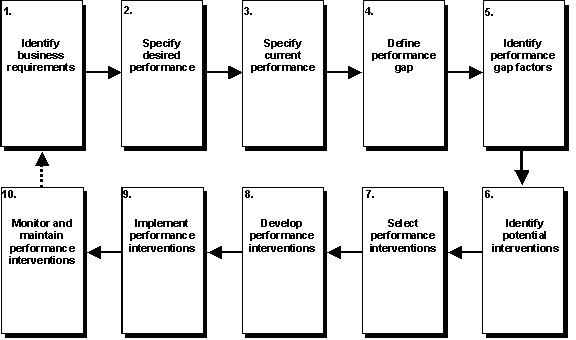
Step 1. Identify Business Requirements
Your performance consulting responsibility, whether you have the title of performance consultant or fulfill the role, is to help your customers, colleagues or organization achieve its performance mission - valued accomplishments - in the most cost-effective and efficient manner that is acceptable to all stakeholders. Unfortunately, only rarely does the true business requirement (or business need) arrive at your doorstep clearly articulated. Generally, you have to hunt for it.
The business requirement comes to you through two approaches:
- Reactively - someone approaches you with a request for help, often presented as training.
- Proactively - you are the initiator. Working with your clients and their organizations, you continuously scan the environment to identify business needs for which changes in people's performance will be necessary.
Identifying the opportunity or receiving the request is only part of the activity in this step. You then have to probe and investigate to determine the business need. Sometimes it teases out fairly easily. Other times you have to really press.
Step 2. Specify Desired Performance
Once you have identified the business requirements, you can zoom in on the desired performance outcomes. When working with your customers, one of the most effective techniques for achieving a starting point for this is to ask the following: "Imagine that your people are doing the job perfectly and that you and all other stakeholders, including the performers are satisfied and delighted. What are they doing and achieving differently from what is currently happening?" Probe encouragingly to draw out all aspects of desired performance.
With these desired performance targets, some of them expressed as behaviors, others as accomplishments, you now have a clearer sense of direction as to what you should be delivering to your customer.
Specification of desired performance in clear, unambiguous terms sets the stage for the remaining steps. Identifying early on whether the source of the desired state is a mandate, a new system or product line introduction, a performance improvement, or any combination of these will help you in collecting detailed information and selecting interventions in later steps.
A final note on specifying desired performance. While your customer may be useful in describing the ideal state, he or she may not be sufficient. Other excellent sources include: documentation, experts and consultants, management, customers, and the performers themselves.
Step 3. Specify Current Performance
Specification of current performance requires going to the source. Although your customer or other persons may be able to give you their observations and opinions, you really require hard data, such as:
|
|
|
|
|
|
|
|
|
|
You would want to augment these with supplementary quantitative information based on direct observation, surveys and questionnaires, interviews, focus groups, even performance tests you or an expert might administer. What guides you in your collection of current performance information is desired performance. If you have clearly specified what is desired, then what you are seeking is to compare the desired behaviors and accomplishments with current performance.
Step 4. Specify Performance Gap
The harder your data in the previous steps, the more specific you can be here. There are three dimensions to a performance gap:
- Magnitude - how big and all encompassing the gap is. Is the distance between desired and actual performance very wide? Is it prevalent throughout the organization or simply local?
- Value - how much the gap represents to the organization in terms of revenues, profits or cost savings.
- Urgency - how quickly it must be resolved. What are the consequences to the organization if not immediately handled?
Step 5. Identify Performance Gap Factors
Factors affecting a performance gap fall into three categories:
- Environmental - These can be external such as changing market conditions, new competitive products, war, the availability of supplies, or more attractive job opportunities elsewhere. They may be internal and stem from organizational changes and pressures, from cultural issues - very frequent when mergers and acquisitions occur or there is a major senior management change - or from job specific factors such as task interferences, inadequate tools and resources, poor incentives, lack of clearly expressed expectations, or insufficient feedback. Environmental factors are usually the most prevalent and have the most impact when there is a lack of desired performance compared to expectations.
- Skill/knowledge - These factors are related to lack of competencies to perform the job. The frequently cited test to determine if it is a lack of skills and knowledge that is the key set of factors to consider in a performance gap is: "If you put a gun to their head, can they perform as desired?" While not a very pleasant question to ask, if the answer is "no," then lack of skills and/or knowledge is a definite factor for consideration.
- Emotional/political - This has to do with factors affecting motivation. These may stem from an overall negative workplace atmosphere - one filled with threats, general unhappiness with working conditions, perceived inequities, harassment or insecurity about the future of the organization. They may also be highly specific and derive from supervisory practices, work cliques, or direct and indirect discriminatory or biased decision making.
Determining the factors and issues that must be dealt with to eliminate the gap between desired and actual is one of your most important tasks. Probably the contribution you can make that will have the most impact is to identify the key factors affecting a gap between desired and current performance. If you do this accurately, the appropriate course of action to achieve performance success emerges naturally. One of your critical roles is that of investigator and analyst. Your mission is to track down and detail the performance gap factors.
Don't forget to catch the rest of the Engineering Effective Performance Model story in the next issue of the HSA e-Xpress.
This
article is an excerpt from Harold Stolovitch and Erica Keeps' award-winning
bestseller, Training Ain't Performance. Interested in learning
more?
Visit https://www.hsa-lps.com/To order.htm#TAP to order a copy of the book.
New Addition to Ain't Series
Harold Stolovitch and Erica Keeps have done it again! The authors of Training Ain't Performance have answered their loyal readers' request for more and have provided a practical guide to help individuals and their organizations fully implement the powerful principles in the best-selling, award-winning book. Beyond Training Ain't Performance Fieldbook provides a clear and concise roadmap for anyone wishing to implement human performance principles in their organization. The useful worksheets and assessments, tools and practical advice will speed your organization toward realizing the value of a performance approach. To make your job even easier, the book includes a CD-ROM with all the needed worksheets and tools to get you started today. Beyond Training Ain't Performance Fieldbook will be launched at the ASTD 2006 International Conference and Expo in May. To order a copy of Beyond Training Ain't Performance Fieldbook, visit https://www.hsa-lps.com/To order.htm#BTAP.
Mem-Cards
Harold Stolovitch and Erica Keeps have teamed up with Mem-Cards to create card-based versions of their best-selling, award-winning books, Telling Ain't Training and Training Ain't Performance.
Mem-Cards are fast-reading, highly-effective cards that present impactful ideas and important insights from professional development books. The substance of each book has been extracted and presented in a way that is both practical and easy-to-use.
Mem-Cards act as instant triggers to on-job applications and serve as just-in-time "coaches." They are compact performance enhancers, helping you do the job or explain what needs to be done.
Mobile Mem-Cards go several steps further, delivering powerful, condensed content to your cell phone, PDA or pocket PC so that you can quickly access, read and listen to important tips, anytime, anywhere. The assessment and testing feature helps strengthen your professional skills and knowledge.
We are excited that Mem-Cards have extended what's in our books directly to the workplace. That's sound performance thinking!
To order the Telling Ain't Training and/or Training Ain't Performance Mem-Cards, contact Michael Altshuler at mla@mem-cards.com. For more information on Mem-Cards, visit their Website at www.mem-cards.com.
Workforce Performance Solutions Columnist
Workforce Performance Solutions is a bi-monthly magazine directed to top-level management, senior human resources, and workforce and organizational development executives whose task is to optimize the abilities of their human assets to drive and improve the execution of enterprise strategy. Harold Stolovitch is the regular "Human Performance" columnist for Workforce Performance Solutions magazine. You can read his latest article, "The Exemplary Performer" by visiting page 16 of the March 2006 digtial edition at http://www.wpsmag.com/digital0306. For more information on Workforce Performance Solutions, visit their Website at www.wpsmag.com. If you have any topics that you would like to see Harold address in his column, please email him at hstolovitch@hsa-lps.com.
Guest Author Series
From time to time, we come across interesting articles that we feel are important to share with others. Our Guest Author Series features these articles by various professional colleagues. The latest in our series is by Marc J. Rosenberg, PhD, CPT. He is a management consultant, educator, and leading expert in the world of training, organizational learning, e-learning, knowledge management, and performance improvement. Marc is a past president of ISPI and the author of two books, the best-selling E-Learning: Strategies for Delivering Knowledge in the Digital Age (McGraw-Hill), and his new book, Beyond E-Learning: Approaches and Technologies to Enhance Organizational Knowledge, Learning and Performance (Pfeiffer). For more information, visit his Website at www.marcrosenberg.com or email him at marc@marcrosenberg.com.
How Will e-Learning Evolve in a Performance-centric World?
By Marc J. Rosenberg
How is e-learning impacted as performance technology takes hold in organizations? When performance, rather than learning, becomes the goal, doors open to a variety of new ways to use new e-learning, information, and collaborative technologies directly in the context of work. What changes lie ahead? Questions such as these are addressed in-depth in the recently released book Beyond E-Learning: Approaches and Technologies to Enhance Organizational Knowledge, Learning and Performance (Pfeiffer, 2005).
E-learning is not really new anymore; most organizations are invested in e-learning programs in one way or another. But our current, comfortable e-learning practices may not fit the new realities of organizational learning and performance. Here are five ways e-learning will evolve in a performance-centric world:
1.
E-learning will be viewed as more than simply "e-training."
This does not lessen the value of quality training, but it is increasingly
clear that the two are not the same. What we commonly refer to as e-learning
is primarily online training. E-learning is much more. In the workplace,
people are more likely to "learn" from access to information
or collaborating with peers and experts than they will from a sole reliance
on courses. Technology enables these capabilities across place and space,
and helps manage the sheer weight of everything everyone must know.
2.
Managing knowledge will be more important than managing courses.
The ability to get information from those who have it to those who need
it-when they need it-will be critical. Training does this-transfers knowledge
and skill from subject matter experts to learners through formal courseware
(classroom and online), but if training, online or otherwise, was the
only way we learned anything, we would all be in class 24-7. Going forward,
we will devote more attention and resources to building high-value, easy-to-use
information repositories for access to the wealth of explicit, codified
information that people need to do their jobs. We will embrace communities
of practice, so that individuals and teams can easily collaborate and
share what they know. And, we must do a better job of leveraging our experts
and their expertise in the organization.
3.
An accelerating shift from formal to informal learning is inevitable.
Even in the best companies, the amount of time individuals can devote
to formal learning (classroom or online training) is around 5% of their
annual work time. The other 95% is spent on the job, where learning is
much more informal, through access to information, colleagues, teams,
and experts. Yet the bulk of training and learning departments' budgets,
staff, and time is devoted to creating formal learning programs, leaving
workplace learning and support to others, including front-line managers.
This is not enough. In the future, training and learning organizations
will discover that their value increasingly lies in supporting people
in the context of actual work, not just in the classroom.
4.
Building sound work processes, rather than continuing to support bad ones,
will require more "upstream" involvement of training, learning,
and performance professionals.
Unfortunately, training is often used to compensate for a bad work process
or poor work documentation. There is far too much investment in training
programs that try to help people deal with work processes that are hard
to manage or just don't "work" at all, or documentation that
isn't easy to follow or just doesn't "document" anything of
value. So we train people to cope, create workarounds, and deal with the
status quo. One reason for this is that the involvement of most training
and learning professionals is too far "downstream" when a work
process or document is too far along to change, or is already implemented.
When we become involved much earlier in the development cycle, we can
embed better learning, information, and performance support tools into
the system from the start. We can also use techniques of performance technology
to better design processes and documents so that less training and support
is needed to perform to standard. This is the ultimate, high-value performance
improvement strategy-creating work process, documentation, and routines
that are so well designed that the need for training is significantly
reduced.
5.
Finally, the success of workplace-based learning and performance approaches
will not depend so much on the sophistication of the technology, but on
acceptance by the organization.
When great technology, and great learning and support, meets an unsupportive
culture, the culture wins every time. That is why the future of e-learning
will not focus on the "e," or even on the "learning,"
but on the organization's readiness to embrace the transformation that
this future represents. Leadership and change management that build a
solid learning culture will be as important as anything else we do, if
we want to be successful.
The continuing growth of traditional e-learning notwithstanding, the overarching
move to a performance-centric world will create profound challenges and
opportunities for us all. As we seek to take advantage of what new technologies
offer, we would do well to redefine our view of e-learning-and learning
in general-and not see our future as simply more of the same.
Reprinted with permission
of the International Society for Performance Improvement from the January
2006 issue of PerformanceXpress (http://www.performancexpress.org/0601/).
Copyright 2006. www.ispi.org
We're
always looking for great articles to include in our Guest Author Series.
If you have any that you would like us to consider, please
contact Erica Keeps at ekeeps@hsa-lps.com.
Upcoming Events
Harold Stolovitch will be presenting at ISPI's Front Range Chapter on April 27 & 28 in Denver, CO. Visit https://www.hsa-lps.com/Events_Summary.htm to view HSA's Events Calendar to learn where and when Harold will be speaking as well as to read session descriptions.
Due to popular demand, Harold will be the principal speaker and facilitator at ASTD's Telling Ain't Training Mini-Conference on October 16 & 17 in Orlando, FL. Visit http://www.astd.org/astd/conferences/TAT/tellingainttraining for more information. He will also lead ASTD's all-new Training Ain't Performance Mini-Conference on October 18 & 19 in Orlando, FL along with Marc Rosenberg, this issue's guest author. Visit http://www.astd.org/astd/Conferences/TAP for more information. Spaces are filling up fast so reserve your spot today!
Ask Harold
Do you have any burning human performance technology questions? Visit the Ask Harold section of HSA's Website and ask your questions for Harold Stolovitch to answer. Here is a recent submission that might intrigue you:
In the world of Competence Assurance and job profiles, what percentage of total tasks/procedures must a candidate be assessed against to assure competence? Is a representative sample of critical tasks sufficient or should you assess against every task/procedure available?
To read the response, visit http://hsa-lps.com/Expert_Q_A.htm#Competence. To ask your own question, visit https://www.hsa-lps.com/Expert_Q_A.htm and fill out the form at the bottom.
Publications
For more information
or to buy copies of our books, visit https://www.hsa-lps.com/To%20order.htm.





If you have any questions or comments, please feel free to contact Samantha Greenhill, Publications and Communications Specialist, at sgreenhill@hsa-lps.com.
To unsubscribe from this Newswire, please reply to this email and put the word UNSUBSCRIBE in the subject line.
© Copyright 2006 Harold D. Stolovitch & Erica J. Keeps