
By Harold D. Stolovitch & Erica J. Keeps
hstolovitch@hsa-lps.com & ekeeps@hsa-lps.com
This is Part 2 of our Performance Improvement Interventions article. In the first half of this article, published in the January 2007 edition of the HSA e-Xpress, we presented Learning Interventions. To access Part I of this article, click here.
Nonlearning Interventions
Nonlearning interventions are actions or events designed to change conditions that facilitate attainment of performance. Anything that removes an obstacle or adds a facilitative element to the performance system qualifies as a nonlearning intervention. Nonlearning interventions fall into three subcategories: performance aids, environmental interventions, and emotional interventions.
Performance Aids
These are external memories performers can call upon as needed. The two major subcategories of performance aids are job aids and performance support tools and systems. Some are static. They provide information or diagrams carefully displayed so that you can easily find the item that tells you what to do or triggers your action. Others are dynamic and offer a pathway, columns of items to choose from, or actual moving displays (electronically or mechanically) that engage you in activities that lead to a desired outcome or spew out responses. In all cases, job aids and performance support tools and systems contain information and procedures you do not have to learn and remember. They all provide you with the right question, answer, or decision for you at the right moment. The only learning you have to do is how to use the performance aid.
Environmental interventions
This set of interventions encompasses an extremely broad grouping. It includes all the adjustments you can make within the work environment, either by eliminating barriers that prevent performance or increasing support mechanisms for obtaining and enhancing desired accomplishments.
Emotional interventions
This subcategory of non-learning interventions includes incentives, consequences, and enhancement of motivation. Incentives are stimulus elements the environment provides that, when perceived as meaningful and valued, increase motivation to perform. Consequences are somewhat akin to incentives but occur after performance. Often these are only discovered once performance is complete. For example, upon cleaning up your office, a person you admire walks in and compliments its look and cleanliness. This is an unanticipated consequence. Breaking a rule where notice of punishments has been posted is an example of an anticipated consequence. Incentives are always known as they are announced beforehand.
Motivation is an internal state and is a response to external events. It is greatly influenced by three key factors:
- Value-how highly a person values the desired performance. The more highly he or she values it, the greater the motivation.
- Confidence-how strongly a person feels she or he will be successful in performing. Under- or overconfidence lowers motivation. The optimal motivating state is one of challenge along with an expectation of success through applied effort.
- Mood-a person's emotional state when required to perform. The more positive the mood the more motivated. Workplace conditions and climate affect mood.
Putting It All Together
The matrix that follows brings together all of the intervention types presented in this article. It is also helpful in sorting out how and when each of these interventions might be used and with what benefits.
Performance Interventions: Putting It All Together
| If your analysis indicates that performers cannot achieve desired results because they… | then select… | such as… | that offers… |
| do not have the necessary skills and knowledge | a learning intervention | natural experience | real-life trial and error learning. |
| experiential learning | real-life learning with structured reflection. | ||
| on-the-job training | informal learning guided by co-workers. | ||
| structured on-the-job training | organized and certified learning guided by trained lead workers. | ||
| simulation | learning through realistic, but not real practice. | ||
| role play | emotional learning (how it feels) through intense participation in realistic scenarios. | ||
| laboratory training | learning from hands-on practice with real objectives and equipment. | ||
| classroom training | learning from an instructor and peers with some practice as feasible. | ||
| self-study | learning on one's own from structured resources. | ||
| do not have the necessary skills and knowledge, but must still produce immediate, near-expert performance | a nonlearning intervention that acts as an external memory or expert guide | job aids | immediate performance of a highly specific nature once use of the job aid has been mastered. Predictable results. |
| performance support system | sophisticated, expert or near expert performance once use of the performance support system has been mastered. | ||
| have a work environment that lacks facilitating elements or presents barriers to achieving desired performance | a nonlearning environmental intervention | provision of information | clear expectations, feedback, and access to unambiguous, required data and guidelines. |
| provision of resources | tools, procedures, processes, time, and support needed to perform. | ||
| work environment redesign | supportive physical, administrative, management, communication, and work-task structures that enhance performance. | ||
| elimination of task interferences | clear focus on priority tasks and results and suppression or reassignment of nonessential activities. | ||
| selection | the right performers for the job in terms of competencies, characteristics, and values. | ||
| provision of support | people, systems, and structures that foster increasingly greater performance through encouragement, monitoring, feedback, and reward. | ||
| have a work environment that does not stimulate, encourage, or reward desired performance or in which performers do not demonstrate an interest to perform as desired | a nonlearning emotional intervention to build commitment, engagement, and perseverance to perform | provision
of incentives/ consequences |
tangible monetary or nonmonetary rewards that performers value for performing as desired or recognition for valued rewards. |
| enhancement of motivation | increased perception of value with respect to desired performance, appropriate level of confidence to succeed, and positive feelings toward achievement of valued results. |
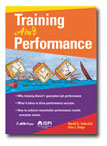
This article is an excerpt from Harold Stolovitch
and Erica Keeps' award-winning bestseller, Training Ain't Performance.
Interested in learning more? Click here
to order a copy of the book.

 Written
by the leading figures in the field, Trends and Issues in Instructional
Design and Technology clearly defines and describes the rapidly converging
fields of instructional design, instructional technology, and performance
technology. The book discusses the trends and issues that have affected
the field in the past and present, and those trends and issues likely
to affect it in the future. It includes writings from Harold Stolovitch,
Walter Dick, Marcy Driscoll, Don Ely, Kent Gustafson, David Hawkridge,
Mike Hannafin, John Keller, David Jonassen, David Merrill, Charlie Reigeluth,
Rita Richey, Allison Rossett, Bob Reiser, and Jack Dempsey. Trends
and Issues in Instructional Design and Technology is the winner of
the 2007 Outstanding Human Performance Communication Award from the International
Society for Performance Improvement.
Written
by the leading figures in the field, Trends and Issues in Instructional
Design and Technology clearly defines and describes the rapidly converging
fields of instructional design, instructional technology, and performance
technology. The book discusses the trends and issues that have affected
the field in the past and present, and those trends and issues likely
to affect it in the future. It includes writings from Harold Stolovitch,
Walter Dick, Marcy Driscoll, Don Ely, Kent Gustafson, David Hawkridge,
Mike Hannafin, John Keller, David Jonassen, David Merrill, Charlie Reigeluth,
Rita Richey, Allison Rossett, Bob Reiser, and Jack Dempsey. Trends
and Issues in Instructional Design and Technology is the winner of
the 2007 Outstanding Human Performance Communication Award from the International
Society for Performance Improvement.
For more information or to order a copy, click here.

 Workforce
Performance Solutions magazine
is now Talent Management magazine. Talent Management is
a monthly magazine directed to top-level management, senior human resources,
and workforce and organizational development executives whose task is
to optimize the abilities of their human assets to drive and improve the
execution of enterprise strategy. Harold Stolovitch is the regular "Human
Performance" columnist for Talent Management magazine. You
can read his latest article, "Talent Management And/Versus Human
Performance" by
visiting page 12 of the March 2007 digtial edition at http://www.nxtbook.com/nxtbooks/mediatec/tm0307/index.php.
For more information on Talent Management, visit their Website
at www.talentmgt.com.
If there are any topics that you would like Harold to address in his column,
please email him at hstolovitch@hsa-lps.com.
Workforce
Performance Solutions magazine
is now Talent Management magazine. Talent Management is
a monthly magazine directed to top-level management, senior human resources,
and workforce and organizational development executives whose task is
to optimize the abilities of their human assets to drive and improve the
execution of enterprise strategy. Harold Stolovitch is the regular "Human
Performance" columnist for Talent Management magazine. You
can read his latest article, "Talent Management And/Versus Human
Performance" by
visiting page 12 of the March 2007 digtial edition at http://www.nxtbook.com/nxtbooks/mediatec/tm0307/index.php.
For more information on Talent Management, visit their Website
at www.talentmgt.com.
If there are any topics that you would like Harold to address in his column,
please email him at hstolovitch@hsa-lps.com.

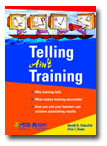 Based
on the award-winning, best-selling books, Telling
Ain't Training and Training
Ain't Performance, the Telling
Ain't Training and Training Ain't Performance workshops have been delivered
to numerous learning and performance professional organizations throughout
the world. Due to the overwhelming response, HSA is now offering the Telling
Ain't Training and Training Ain't Performance one-day event to companies
worldwide.
Based
on the award-winning, best-selling books, Telling
Ain't Training and Training
Ain't Performance, the Telling
Ain't Training and Training Ain't Performance workshops have been delivered
to numerous learning and performance professional organizations throughout
the world. Due to the overwhelming response, HSA is now offering the Telling
Ain't Training and Training Ain't Performance one-day event to companies
worldwide.
Telling
Ain't Training Half-Day Workshop
We derive our most valuable lessons from what we experience, not from
what we are told. This session takes a light-hearted, experiential approach
to transforming telling (a waste of time) into activities that result
in long-term retention and behavior change. Through a series of hands-on
exercises, participants will not only have fun learning, but will also
acquire some research based principles for building retention and improved
performance.
Training
Ain't Performance Half-Day Workshop
"They learned it, so why aren't they producing the results?"
This half-day, hands-on workshop opens with a real-world case that sets
the stage for discriminating between training and performance. It provides
you with models, tools and examples for handling training requests from
a "performance" perspective. You get to practice performance
consulting, analytic skills on real-world projects in small groups with
guidance and coaching. You also receive a comprehensive reference manual
complete with job aids to support you in your next project.
This workshop is particularly useful for those who are faced with training requests and have little or no formal training in playing a performance consulting role with their internal or external clients.
Reserve
Now!
Our calendar is filling up fast so don't delay. Book your in-house Telling
Ain't Training and Training Ain't Performance one-day event today! Contact
Erica Keeps at ekeeps@hsa-lps.com
or (310) 286-2722 for more information or to reserve your date/s.
Haven't
read Telling Ain't Training and/or
Training Ain't Performance yet?
What are you waiting for? Click here
to order today!

Until April 30, 2007, receive 20% off the list price when you buy one of our Pfeiffer Learning & Performance Toolkit Series titles or 30% off when both are purchased together.
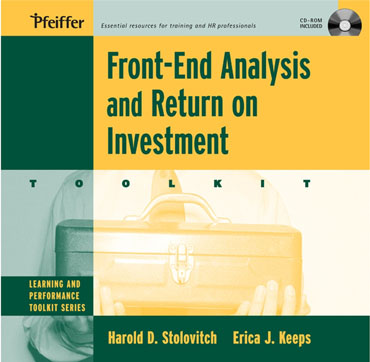 Front-End
Analysis and Return on Investment Toolkit is a comprehensive
collection of guidelines, job aids, rich examples and tips that give readers
the information needed to create performance interventions that will deliver
the desired results. It also includes a robust "plug and play"
CD-ROM that helps users actually derive a bottom-line ROI number. By using
this vital resource you will be able to analyze training requests on the
front end, measure worth and ROI in learning and performance on the back
end, as well as much more.
Front-End
Analysis and Return on Investment Toolkit is a comprehensive
collection of guidelines, job aids, rich examples and tips that give readers
the information needed to create performance interventions that will deliver
the desired results. It also includes a robust "plug and play"
CD-ROM that helps users actually derive a bottom-line ROI number. By using
this vital resource you will be able to analyze training requests on the
front end, measure worth and ROI in learning and performance on the back
end, as well as much more.
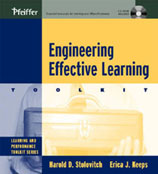 Engineering
Effective Learning Toolkit is a hands-on resource that offers
a systematic, 14-step approach for designing and evaluating successful
training, learning and performance projects. The accompanying CD-ROM includes
easily reproducible and customizable charts and job aids to help you accomplish
each step in the instructional design process.
Engineering
Effective Learning Toolkit is a hands-on resource that offers
a systematic, 14-step approach for designing and evaluating successful
training, learning and performance projects. The accompanying CD-ROM includes
easily reproducible and customizable charts and job aids to help you accomplish
each step in the instructional design process.
Simply visit www.pfeiffer.com and enter promo code W77PS during checkout to receive the discount.

 Already
read Telling Ain't Training
and/or Training Ain't Performance?
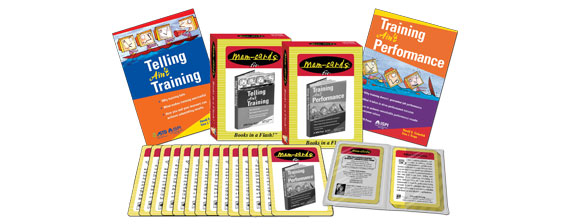
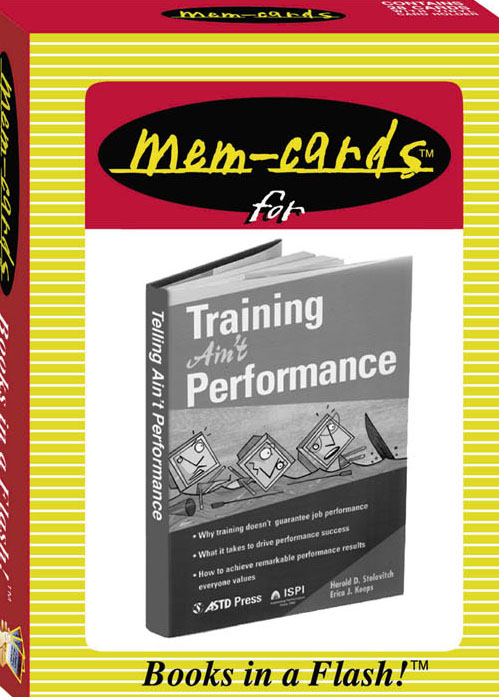
Now you can go one step further with Mem-Cards. Mem-Cards are fast-reading,
highly-effective cards that present impactful ideas and important insights
from Harold Stolovitch and Erica Keeps' best-selling, award-winning books.
Already
read Telling Ain't Training
and/or Training Ain't Performance?
Now you can go one step further with Mem-Cards. Mem-Cards are fast-reading,
highly-effective cards that present impactful ideas and important insights
from Harold Stolovitch and Erica Keeps' best-selling, award-winning books.
The key information of each book has been extracted and presented in a way that is both practical and easy-to-use. Mem-Cards act as instant triggers to on-job applications and serve as just-in-time "coaches." They are compact performance enhancers, helping you do the job or explain what needs to be done.
With the purchase of 10 Telling Ain't Training and/or Training Ain't Performance Mem-Card decks, receive a free Games Booklet with 20 games to play with your Mem-Cards. Mem-Card decks are only $14.95 each. Quantity discounts are also available. For a list of prices, click here.
To
order your Mem-Cards, contact Erica Keeps at ekeeps@hsa-lps.com.

Our Guest Author Series
features interesting articles by various professional colleagues. The
latest in our series is by Dr. Roger M. Addison, CPT. Roger is an internationally
respected practitioner of Human Performance Technology (HPT) and performance
consulting. He is the Senior Director of Human Performance Technology
for the International Society for Performance Improvement (ISPI). He consults
with Fortune 500 organizations to help them align their business requirements
with bottom line results. As an international delegate to International
Federation of Training
and Development Organisations, Ltd. (IFTDO) and ISPI conferences, Roger
has worked and presented in North America, South America, Asia, Europe,
Africa, and the Middle East. He can be reached at Roger@ispi.org.
Performance Technology: The Integrator
By Dr. Roger M. Addison, CPT
 A
Problem
A
Problem
Today, most organizations embrace the value of improving the performance
of their employees and have made investments in specialists and materials
to realize better results. Such performance improvement efforts may take
many different approaches within a single organization and are usually
conceived and implemented in splendid isolation. Unfortunately, when these
initiatives are not integrated into the enterprise's total performance
system, the outcome is general confusion and diluted achievements for
the affected workforce and the organization.
Organizations would be well served by an integrative approach that could unite a variety of performance improvement initiatives by showcasing their commonalities and applying them across the three levels of the organization: worker, work, and workplace.
A
Proposal
Performance Technology (PT) is such an integrative approach. A powerful
systematic process that can help integrate performance improvement initiatives
at all three organizational levels, PT links business, education, and
government goals and strategies to workforce responsibilities for achieving
results. PT enables the identification of opportunities and analyzes performance
problems. PT helps design systems that enable people to do their best
work, producing results that are valuable to the organization.
PT can support individuals, teams, organizations, and society in cost-effectively increasing the value of results they produce. PT methodologies and applications are numerous and varied, however all are focused on the same fundamental principles, RSVP-Plus.
- Results focused - start with the end in mind
- Systemic - take a systems viewpoint
- Value added - focus on what matters to the enterprise
- Partner - with clients and other performance professionals
- Plus
- the added objectivity of solution-independent analyses
The power of PT resides in the performance improvement professionals who use the many models, tools, and techniques to align activities among:
- The workers, individuals and teams
- The work, activities, processes, and operations
- The workplace, organization, enterprise
- Society
A
PT Professional's Profile
Rather than defining ourselves by the solutions we develop or recommend,
performance improvement professionals take a comprehensive systems view
of performance. We focus on the alignment of an organization's total performance
system. This includes the:
- Environment
- Culture
- Inputs
- Processes
- Outputs
- Feedback
- Consequences
- Stakeholders
Performance improvement professionals apply a systematic approach by determining the need or opportunity; defining the requirements; determining the performance gaps, causes, and drivers; designing/developing solutions; implementing and evaluating results for continuous improvement, and embedding Performance Technology in the organization to produce sustainable results.
The PT methodologies and applications we use are numerous and varied. However, all contribute to the accomplishment of one or more of the following:
- Value Identified - Clarify the problem, issue, or opportunity
- Outcomes Defined - Specify the requirements to close the business gap between existing and desired results and create value
- Performance Analyzed - Identify the factors in the performance system that can influence the production of outcomes to meet requirements
- Solution Selected - Identify and select from a range of possible PT applications that best meet the requirements, given the information about outcomes and performance
- Solution Designed/Developed - Plan and build solution and materials including decisions about what it will take to cost-effectively implement the solution and match culture requirements
- Solution Deployed - Execute the design to meet requirements
- Solution Evaluated - Measure results to determine how well the requirements were met and what might be required to further improve results
- Performance Technology Embedded - Increase the sustainability of performance-bases solutions in the enterprise
The
Integrator
The competing performance improvement models, tools, and techniques used
today range from organization development to six sigma, to human resource
development. Each approach to improving performance has its own models,
language, and tools and is often deployed in just one part of the organization.
To add to the confusion and lack of communication, each area may report
to a different executive.
Nevertheless, as we have seen, these methodologies have more commonalities than they have differences. And the differences are in the terminology used and perhaps in organizational focus. With our sights clearly fixed on proven sustained results, PT methods, tools and techniques can be used to integrate performance improvement initiatives across the organization. The power of Performance Technology is not in emphasizing the means but rather the ends. The integration of the worker, work, and workplace is the key to improved organizational performance.
© 2007 Roger M. Addison
We're
always looking for great articles to include in our Guest Author Series.
If you have one that you would like us to consider, please contact
Erica Keeps at ekeeps@hsa-lps.com.

Harold Stolovitch will be presenting at the International Society for Performance Improvement's (ISPI) International Conference on May 1, 2007 in San Francisco, CA and the ISPI Orange County Chapter on May 30, 2007 in Irvine, CA. Click here to view HSA's Events Calendar to learn where and when Harold will be speaking as well as to read session descriptions.

Due to popular demand, Harold will be the principal speaker and facilitator
at ASTD's Telling Ain't Training Mini-Conference on October 1& 2,
2007 in Arlington, VA. Click here
for more information.

 Those
of you who know Harold Stolovitch know that whatever Harold does, he's
passionate about. Take instructional and performance technology for example.
Those
of you who know Harold Stolovitch know that whatever Harold does, he's
passionate about. Take instructional and performance technology for example.
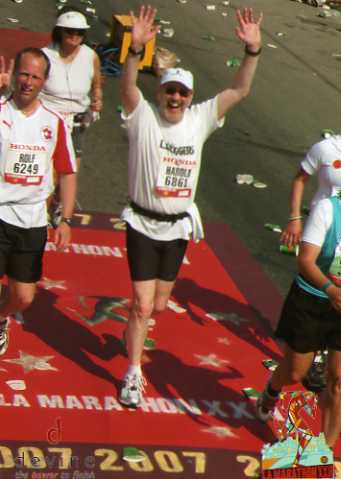
You may not know that Harold is a devoted long distance runner. He successfully completed both the 2006 and 2007 Los Angeles Marathons (see photos) as well as the Paris Marathon on April 15, 2007. What challenges lie ahead? Next time you speak to Harold, just ask him!

 Do
you have any burning human performance technology questions? Visit the
Ask Harold section of HSA's Website
and ask your questions for Harold Stolovitch to answer. Here is a recent
submission that might intrigue you:
Do
you have any burning human performance technology questions? Visit the
Ask Harold section of HSA's Website
and ask your questions for Harold Stolovitch to answer. Here is a recent
submission that might intrigue you:
How can the use of effective job feedback designs or job aids replace on-the-job training? Under what conditions would formal training be a better solution?
To read the response, visit Ask Harold. To ask your own question, just click on the crystal ball above, fill out the form and click submit.

Click on any of the covers below for more information or to buy copies of our books and learning aids.

For more information on HSA, visit our Website
at www.hsa-lps.com, email us at info@hsa-lps.com
or call us toll free at 1-888-834-9928.If you have any questions or comments, please feel free to contact Samantha Greenhill, Publications and Communications Specialist, at sgreenhill@hsa-lps.com.

To unsubscribe from this Newswire, please reply to this email and put the word UNSUBSCRIBE in the subject line.
© Copyright 2007 Harold D. Stolovitch & Erica J. Keeps