
By Harold D. Stolovitch & Erica J. Keeps
hstolovitch@hsa-lps.com & ekeeps@hsa-lps.com
Your role as a consultant in workplace learning and performance is so much richer than that of training or any other single solution order-taker. It is no wonder the training and human resource development worlds are rapidly evolving in this direction.
Examine the list below that presents some statements of value that you add in assuming a performance-consulting role:
- You guide clients to separate the ends they wish to achieve from the intuitively selected (and often inappropriate or incomplete) solutions they ask for, and then you help them focus on those ends.
- You help your clients articulate success criteria and meaningful metrics to verify whether or not their valued ends have been achieved. This, in turn, enables them to display meaningful results to their managers, customers and workers.
- You educate your clients, opening their eyes to an entire spectrum of means for attaining their goals.
- You offer a broad menu of interventions that equip your clients that allow them to attack their performance gaps more systematically than they could with simple "miracle cures." This increases their probability of performance success.
- You save time and money. Your aim is to achieve maximum impact at the minimum cost in time, resources and dollars.
- You help your clients, the targeted performers and the organization optimally leverage their human capital potential by focusing on efficient attainment of results rather than on activities (such as training) that may be unnecessary or insufficient to do the job.
The information in Table 1 serves two purposes: to reinforce your need as a performance consultant to build strength in each competency; and to demonstrate to your clients, who are often impatient and want a "quick fix," that what you do benefits them beyond their current expectation levels.
Table 1. Performance Consulting Competency Areas and Their Value Add
|
Competency
Area
|
Value
Add
|
|
1.
Determine performance improvement projects appropriate to tackle
|
|
| 2. Conduct performance gap analysis |
|
| 3. Assess performer characteristics |
|
| 4. Analyze the structures of jobs, task and content |
|
| 5. Analyze the characteristics of a learning/working environment |
|
| 6. Write statements of performance intervention outcomes |
|
| 7. Sequence performance intervention outcomes |
|
| 8. Specify performance interventions and strategies |
|
| 9. Sequence performance improvement activities |
|
| 10. Determine resources appropriate for performance improvement activities and help obtain them |
|
| 11. Evaluate performance improvement interventions |
|
| 12. Create a performance improvement implementation plan |
|
| 13. Plan, manage and monitor performance improvement projects |
|
| 14. Communicate effectively in visual, oral and written form |
|
| 15. Demonstrate appropriate interpersonal, group process and consulting skills |
|
|
16. Promote performance-consulting and human performance improvement as a major approach to achieving desired results in organizations |
|
In addition to the added value the 16 performance-consulting competencies bring to a project and all its stakeholders, the competencies also define the 10 vital characteristics displayed by outstanding performance consultants. Table 2 summarizes these characteristics. As in the previous table, we add here in brief form what value they provide to clients, performers, the organization, customers and all other direct or indirect stakeholders.
Table 2. Performance Consultant Characteristics and the Value Add
|
Characteristic
|
Value
Add
|
|
1. Is focused on client need:
|
|
|
2. Is cause-conscious, not solution-focused:
|
|
|
3. Is able to maintain a system perspective:
|
|
|
4. Is capable of involving others (authority figures, knowledgeable individuals) appropriately:
|
|
|
5. Is organized, rigorous, prudent:
|
|
|
6. Is sensitive to the need to verify perceptions:
|
|
|
7. Is able to sort out priorities:
|
|
|
8. Is diplomatic and credible:
|
|
|
9. Is generous with giving credit to others:
|
|
|
10. Is principled but flexible:
|
|
As a performance professional - a performance consultant - you can effect large changes within your organization. These competencies and characteristics are your own personal targets. Keep in mind the added value each one brings to you and your clients.
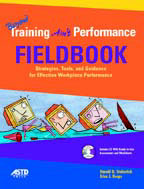
This article is an excerpt from Harold Stolovitch and Erica Keeps' bestseller,
Beyond Training Ain't Performance Fieldbook.
Interested in learning more? Click here
to order a copy of the book.

 Talent
Management is a monthly magazine directed to top-level management,
senior human resources, and workforce and organizational development executives
whose task is to optimize the abilities of their human assets to drive
and improve the execution of enterprise strategy. Harold Stolovitch is
the regular "Human Performance" columnist for Talent Management
magazine. You can read his latest article, "When Business Declines,
Focus on Alterations" by
visiting page 16 of the April 2008 digtial edition at http://www.nxtbook.com/nxtbooks/mediatec/tm0408/.
For more information on Talent Management, visit their Website
at www.talentmgt.com.
If there are any topics that you would like Harold to address in his column,
please email him at hstolovitch@hsa-lps.com.
Talent
Management is a monthly magazine directed to top-level management,
senior human resources, and workforce and organizational development executives
whose task is to optimize the abilities of their human assets to drive
and improve the execution of enterprise strategy. Harold Stolovitch is
the regular "Human Performance" columnist for Talent Management
magazine. You can read his latest article, "When Business Declines,
Focus on Alterations" by
visiting page 16 of the April 2008 digtial edition at http://www.nxtbook.com/nxtbooks/mediatec/tm0408/.
For more information on Talent Management, visit their Website
at www.talentmgt.com.
If there are any topics that you would like Harold to address in his column,
please email him at hstolovitch@hsa-lps.com.

Harold Stolovitch will be presenting a keynote address at the Talent Management magazine event: Strategies 2008: Perspectives on Managing People on May 5 in Scottsdale, AZ. Click here to view HSA's Events Calendar to learn where and when Harold will be speaking as well as to read session descriptions.
 Due to popular demand, Harold will be the principal speaker and facilitator
at ASTD's Telling Ain't Training Mini-Conference on October 21 & 22
in Chicago, IL and on November 6 & 7 in Washington, DC. Click here
for more information.
Due to popular demand, Harold will be the principal speaker and facilitator
at ASTD's Telling Ain't Training Mini-Conference on October 21 & 22
in Chicago, IL and on November 6 & 7 in Washington, DC. Click here
for more information.

 Do
you have any burning Human Performance Technology questions? Visit the
Ask Harold section of HSA's Website
and ask your questions for Harold Stolovitch to answer. Here is a recent
submission that might intrigue you:
Do
you have any burning Human Performance Technology questions? Visit the
Ask Harold section of HSA's Website
and ask your questions for Harold Stolovitch to answer. Here is a recent
submission that might intrigue you:
I'm a training professional working in the pharmaceutical industry and am seeking a basic competency model detailing what performance looks like for classroom trainers. Ideally the model would describe performance at three different levels: basic/fundamental, intermediate and advanced. Can you point me in the right direction?
To read the response, visit Ask Harold. To ask your own question, just click on the crystal ball above, fill out the form and click submit.

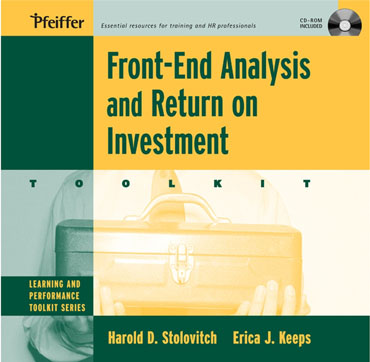
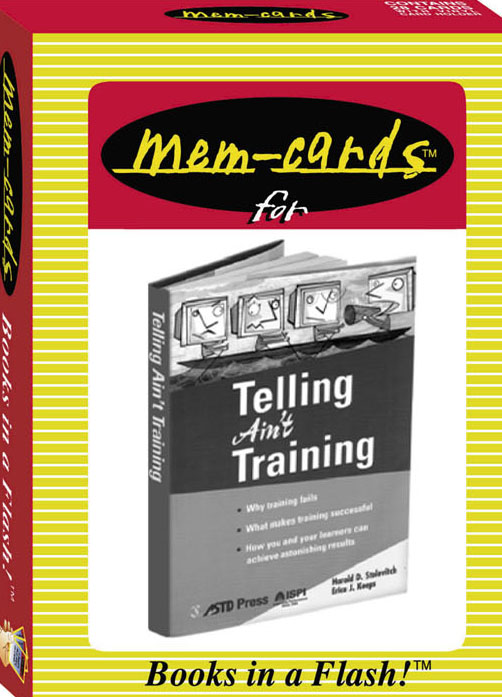
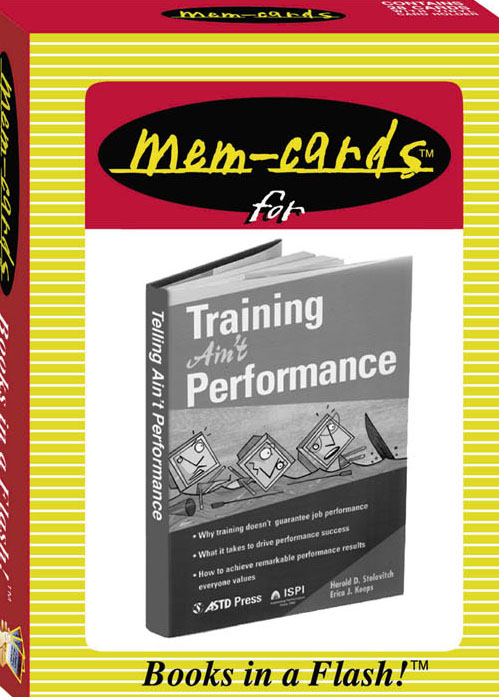
Click on any of the covers below for more information or to purchase copies of our books and learning aids.
For more information on HSA, visit our Website
at www.hsa-lps.com, email us at info@hsa-lps.com
or call us toll free at 1-888-834-9928.If you have any questions or comments, please feel free to contact Samantha Greenhill, Publications and Communications Specialist, at sgreenhill@hsa-lps.com.

To unsubscribe from this Newswire, please reply to this email and put the word UNSUBSCRIBE in the subject line.
© Copyright 2008 Harold D. Stolovitch & Erica J. Keeps