
By Harold D. Stolovitch & Erica J. Keeps
hstolovitch@hsa-lps.com & ekeeps@hsa-lps.com
 This
brief article provides an easy-to-follow model for debriefing experiential
exercises. The case study, game (or game-like activity) has ended and
lots of things have occurred during the session that have provided strong
learning opportunities for the participants. How do you capture all that
went on? How do you organize the mass of events, feelings, experiences
and insights into some sort of coherent form? The answer: through a carefully
structured debriefing such as the six-step D-FITGA debriefing described
below.
This
brief article provides an easy-to-follow model for debriefing experiential
exercises. The case study, game (or game-like activity) has ended and
lots of things have occurred during the session that have provided strong
learning opportunities for the participants. How do you capture all that
went on? How do you organize the mass of events, feelings, experiences
and insights into some sort of coherent form? The answer: through a carefully
structured debriefing such as the six-step D-FITGA debriefing described
below.
- Decompression. During a good case, game or game-like activity, participants become dramatically and emotionally involved in what they are doing. They gather and process information rapidly, make decisions, test hypotheses, create strategies, and manipulate and even sometimes crush other participants. The level of involvement is high. Feelings build up and occasionally boil over. Frequently, some emotional residue remains after the activity ends. The experienced leader will help his or her group relax and decompress from the activity. Here are some decompression suggestions:
- Call a break to allow participants to freely move around, talk and refresh themselves.
- Regroup the participants into an informal and comfortable seating arrangement. Let them relax.
- Have group members close their eyes, breathe deeply and think of dark swirling colors. Call up a pleasant image.
- Have participants close their eyes, stretch, then relax. Have them start at the top of the head and then slowly push the tensions out of their bodies through their fingers and toes.
- Spend, in all, some three to five minutes unwinding and settling down the group.
- Facts. Focus your opening debriefing questions on factual information. Ask participants to recall events that occurred during the activity. Avoid suppositions or inferences. If you have taken notes during the play of the game or the acting out of a scene, refer to these and have participants tell it their way. Below are some sample types of fact questions you could ask:
- Did anyone receive a green card? Who gave it to you? What significance did you attach to it?
- Who had more then 15 points? What strategy did you choose to get them? Did anyone make any remarks about your strategy? What did she or he say?
- When the newcomer arrived in your room, what did you do? How did you treat him or her? How did the newcomer react? Would someone who played the role of a newcomer tell us what he or she perceived on entering the room?
- Inferences. When facts are established, the leader can begin questioning participants on what they thought or imagined was occurring. Questions here focus on judgment and the seeking of causes. Inferences can be confirmed or negated by other participants. All this should come out during the inferential phase of debriefing. Here are some sample debriefing questions and comments for this phase:
- Did anyone suspect that a trap was being set for him or her? What made you suspicious? What do you think was causing him to be so cautious even though you were obviously hurt?
- Why do you imagine
the doctor refused assistance? Would you have done the same?
- Why do you think you were thrown out of the room? Do you think the hostile actions were justified by your conduct? Were they acting reasonably?
- Transfer. In this phase, the debriefing tries to draw parallels among the events, characters, circumstances of the activity and the participants' real work situations. Questions thus focus on comparisons between the activity and everyday life. Here are some sample questions for this transfer phase:
- Do you see any similarities between the way in which the doctor treated the victim and persons or events in your work setting? How do people in authority deal with those who appear to be powerless? Or powerful?
- In the game, many of you learned the advantage of forming coalitions to survive. Would that work in your real-world setting?
- When you were punished for errors as you tried to follow directions, you soon gave up and became apathetic. Do things like this happen in real life? Give me some personal examples.
- You did your best in the other culture and still you were treated with disdain and were rejected. You began to feel hostile. Have similar events occurred to you at work? Give us an example.
- Generalizations. Once similarities between activity and reality have been established, the next phase is to try to create some generalizations, rules and principles to improve or help us better understand the real world. For example:
- You felt powerless and defeated by the doctor's treatment of you. You turned resentful and uncooperative. What does that tell us about people treated this way by authority figures? What can we personally do about it?
- You saw that banding together improved the survival rate of the group. What principle can we come up with that should help us survive better in our work?
- So when you were rejected, you turned hostile. What does that tell us about tensions between different cultural groups? How do we diminish the hostility?
- Applications. The final step, if it is feasible, is to lead participants to the point where they can apply generalizations, very concretely, to their own specific realities. Here are some questions:
- What will you do the next time you see abuse of authority occurring in your setting?
- You say that punishing effort decreases effort and discourages individuals from trying to solve problems. What can you do to change the punishing aspects of your work environment?
- If banding together improves the lot of everyone, what impact could that have on your situation? What can you and others do to increase cooperation and mutual assistance?
Debriefing is a fine
art. It can be structured and planned, but it takes on a dynamic form
of it own as participants become involved. Using a blackboard, whiteboard
or flipchart to highlight key points, using human recorders to write down
decisions that are made and harmoniously building toward the same outcomes
as the original activity sought to reach will increase the overall impact
of your case, game or game-like learning session.
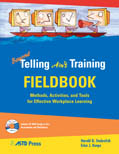
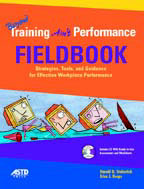
This article is an excerpt from Harold Stolovitch and Erica Keeps' bestseller,
Beyond Telling Ain't Training Fieldbook.
Interested in learning more? Click here
to order a copy of the book.

 Talent
Management is a monthly magazine directed to top-level management,
senior human resources, and workforce and organizational development executives
whose task is to optimize the abilities of their human assets to drive
and improve the execution of enterprise strategy. Harold Stolovitch is
the regular "Human Performance" columnist for Talent Management
magazine. You can read his latest article, "Help-less Desk to Help-ful
Performance Support Resource" by
visiting page 12 of the April 2009 digtial edition at http://www.talentmgt.com/digital-edition/2009/04/.
For more information on Talent Management, visit their Website
at www.talentmgt.com.
If there are any topics that you would like Harold to address in his column,
please email him at hstolovitch@hsa-lps.com.
Talent
Management is a monthly magazine directed to top-level management,
senior human resources, and workforce and organizational development executives
whose task is to optimize the abilities of their human assets to drive
and improve the execution of enterprise strategy. Harold Stolovitch is
the regular "Human Performance" columnist for Talent Management
magazine. You can read his latest article, "Help-less Desk to Help-ful
Performance Support Resource" by
visiting page 12 of the April 2009 digtial edition at http://www.talentmgt.com/digital-edition/2009/04/.
For more information on Talent Management, visit their Website
at www.talentmgt.com.
If there are any topics that you would like Harold to address in his column,
please email him at hstolovitch@hsa-lps.com.

 Have
you made your plans to join ASTD for the Telling Ain't Training Conference?
Based on the best selling book of the same name, this conference explores
the art of engaging employees in training programs using interactive activities
to stimulate conversation and interest.
Have
you made your plans to join ASTD for the Telling Ain't Training Conference?
Based on the best selling book of the same name, this conference explores
the art of engaging employees in training programs using interactive activities
to stimulate conversation and interest.
This year there are three chances to attend this popular event, including a one day program with Harold Stolovitch in partnership with the Canadian Society for Training & Development in Toronto, Canada. The dates for this year's conferences are: July 15 & 16 in Chicago, IL, October 14 & 15 in Atlanta, GA and October 23 in Toronto, Canada.
The 2007 and 2008 conferences sold out, so make sure to act fast. Register today and gain valuable tools to improve your training programs and promote long-term retention and behavioral change in your organization. For more information, visit tat.astd.org.

 Dr.
Harold Stolovitch, Emeritus professor, Human Performance at Work and Principal
of HSA Learning & Performance Solutions, has successfully developed
workplace learning and performance professionals for over 40 years. He
is an experienced keynote speaker, workshop leader, author and consultant
who has worked with hundreds of major corporations and professional organizations
throughout the world.
Dr.
Harold Stolovitch, Emeritus professor, Human Performance at Work and Principal
of HSA Learning & Performance Solutions, has successfully developed
workplace learning and performance professionals for over 40 years. He
is an experienced keynote speaker, workshop leader, author and consultant
who has worked with hundreds of major corporations and professional organizations
throughout the world.
Harold is available for presentations, keynote addresses, consulting and workshops at corporations and professional organizations. Click here for more information.

Our Guest Author Series
features articles by various professional colleagues. The latest in our
series is by Dr. Sylvie Vanasse. Sylvie is the Director of People for
Parsons Brinckerhoff Australia. She can be reached by email at svanasse@pb.com.au.
Growing Future Leaders From Within
By Dr. Sylvie Vanasse, Parsons Brinckerhoff Australia
An undisputed shortage of engineers, scientists and planners places significant pressure on leaders of consulting firms to develop strategies to maximize their recruitment efforts and increase attempts to retain critical employees. Such strategies aim at not only reducing the costs involved in repetitious recruitment, but also at controlling the loss of talent to competitors, clients and other industries.
According to a Mckinsey study, one of the top three reasons employees leave an organisation is due to feeling under-valued. Leaders need to establish positive relationships with their employees to encourage a sense of being valued by the organisation. In addition, a business must become creative in designing the right incentives to both attract and retain talented employees.
At Parsons Brinckerhoff (PB) we have implemented a number of measures to ensure our employees feel valued and to stem the loss of our talent. One of these strategies is our succession planning program or Accelerated Development Program (ADP).
Overview
of the Program
The purpose of the ADP is to identify and accelerate the development of
our future leaders. A study conducted by Development Dimensions International
(DDI) claims that strong leadership development and succession planning
can lead to an increase of 20% in financial performance, 14% in employee
satisfaction and 17% in retention of quality employees.
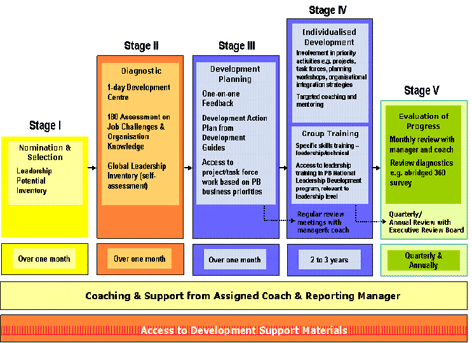
As illustrated below, the ADP moves participants through five stages. The program activities take place under the supervision of both a personal coach and an Executive Review Board (ERB) composed of senior managers.
Stage
I - Nomination & Selection
The program starts with a rigorous and objective nomination and selection
process. The goal is to avoid the common pitfall of promoting individuals
solely based on their technical abilities and current performance, as
has been the practice in many technically-based firms. According to the
Corporate Leadership Council, individuals with strong technical abilities
and deemed to be high performers, but displaying low level of leadership
aspiration, have only a 44% chance of success when promoted. Typically,
approximately 10% of the total workforce may be identified as having the
potential to be promoted. Multiple assessors review each nominated individual
against a series of leadership potential criteria. Ultimately, only about
2% of the workforce is selected and invited into the program.
Stage
II - Diagnostic
During this phase, each program participant attends a one-day assessment
center facilitated by an external firm. Throughout the day, participants
are involved in simulations, role plays, case studies and presentations
where they are given the opportunity to demonstrate leadership characteristics
required for their potential future roles.
Stage
III - Development Planning
Successful candidates are debriefed on their assessment center results
and create an individual development plan with the assistance and guidance
of the external firm and their personal coaches. The plan focuses on on-the-job
challenges that will stretch individuals' performance and learning.
Stage
IV - Individual and Group Learning
During this stage, participants progress through their development plans
by undertaking challenging on-the-job assignments or projects and attending
group learning sessions. These activities are conducted with the support
of the participants' coaches and other mentors. This stage may last two
to three years until individuals feel they have gained maximum benefit
from the program. This may occur before or after promotion.
Stage
V - Evaluation of Progress
Quarterly and annually, the ERB contacts each participant to review progress
and to discuss challenges, obstacles and future opportunities. The ERB
is also consulted with regard to the eventual promotion of program participants.
Conclusion
A few years ago, PB launched its succession planning program - the ADP
- focused on supporting and developing its future generation of leaders.
Participants have demonstrated their enthusiasm for the program in their
coaching sessions and through their involvement in a broad range of initiatives.
Initial reviews show very promising results, with all participants continuing
their commitment to the program and PB. The third round of ADP was launched
in September 2008 and the retention rate of all participants, including
Alumni, since 2006 has been 98%!
We're looking for articles to include in our Guest Author Series. If you have one that you would like us to consider, whether it be new or previously published elsewhere, please contact Erica Keeps at ekeeps@hsa-lps.com.

 Harold
Stolovitch will present at the following organizations in the upcoming
future:
Harold
Stolovitch will present at the following organizations in the upcoming
future:
- Training & Development Conference - May 25, 2009 in Athens, Greece. He will present a keynote address, Stop Wasting Money on Training.
- ASTD Telling Ain't Training Conference - July 15 & 16, 2009 in Chicago, IL. He will be the principal speaker and facilitator.
- ASTD Telling Ain't Training Conference - October 14 & 15, 2009 in Atlanta, GA. He will be the principal speaker and facilitator.
- ASTD Telling Ain't Training Conference - October 23, 2009 in Toronto, Canada. He will be the principal speaker and facilitator.
- ASTD Los Angeles Chapter - November 12 & 13, 2009 in Los Angeles, CA. He will conduct his Systematic Course Development Workshop.
- ISPI Michigan Chapter - November 19 & 20, 2009 in Detroit, MI. He will present Discoveries and conduct his one-day Training Ain't Performance workshop.
- ASTD Los Angeles Chapter - December 10 & 11, 2009 in Los Angeles, CA. He will conduct his Front-End Analysis workshop and a half-day Return on Investment workshop.
Click here to view HSA's Events Calendar to learn where and when Harold will be speaking as well as to read session descriptions.

 The
adventure continued this year (February 22 - March 1, 2009) with a splendid
Mexican Riviera cruise on Royal Caribbean Cruise Line's Mariner of the
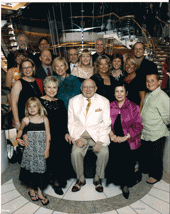
Seas. Our group of 18 (ages 6 to 89, pictured at right) had full days
with activities galore from rock climbing, miniature golf and basketball
to ice and inline skating right on board. Evenings were fabulous with
Las Vegas-style shows, comedians, live game shows, a Cirque de Soleil-style
ice skating performance and a multitude of lounges with music to listen
and/or dance to. Everyone did their own thing by day (variety of land
excursions and at sea activities). However, the group convened each evening
for dinner and conversation.
The
adventure continued this year (February 22 - March 1, 2009) with a splendid
Mexican Riviera cruise on Royal Caribbean Cruise Line's Mariner of the
Seas. Our group of 18 (ages 6 to 89, pictured at right) had full days
with activities galore from rock climbing, miniature golf and basketball
to ice and inline skating right on board. Evenings were fabulous with
Las Vegas-style shows, comedians, live game shows, a Cirque de Soleil-style
ice skating performance and a multitude of lounges with music to listen
and/or dance to. Everyone did their own thing by day (variety of land
excursions and at sea activities). However, the group convened each evening
for dinner and conversation.
Consider cruising
with us in the future. We'll keep you posted on upcoming opportunities
to join us. The possibilities are endless!

 Do
you have any burning Human Performance Technology questions? Visit the
Ask Harold section of HSA's Website
and ask your questions for Harold Stolovitch to answer. Here is a recent
submission that might intrigue you:
Do
you have any burning Human Performance Technology questions? Visit the
Ask Harold section of HSA's Website
and ask your questions for Harold Stolovitch to answer. Here is a recent
submission that might intrigue you:
I
am a senior in university and want to go into human capital consulting
after graduation in May. I was wondering what positions are open for recent
graduates.
To read
the response, visit Ask
Harold. To ask your own question, just click on the crystal
ball at left, fill out the form and click submit.

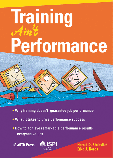
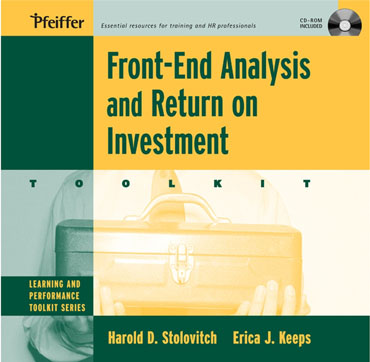
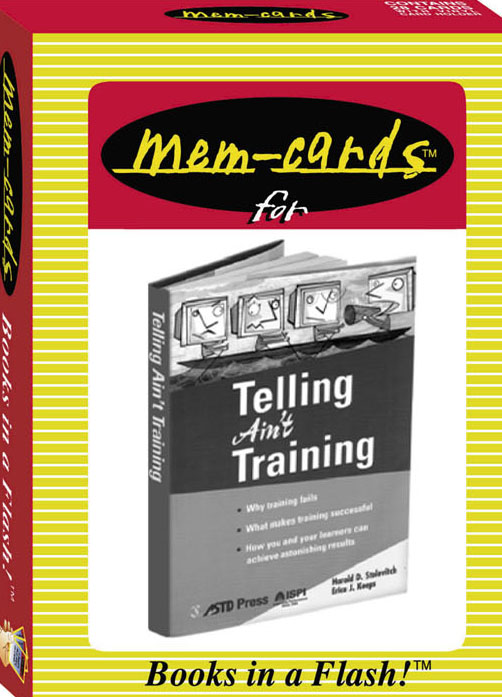
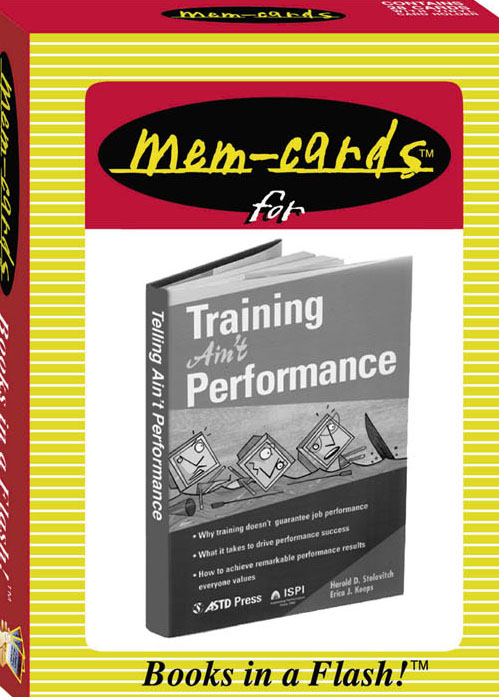
Click on any of the covers below for more information or to purchase copies of our books and learning aids.
For more information on HSA, visit our Website
at www.hsa-lps.com, email us at info@hsa-lps.com
or call us toll free at 1-888-834-9928.If you have any questions or comments, please feel free to contact Samantha Greenhill, Publications and Communications Specialist, at sgreenhill@hsa-lps.com.

To unsubscribe from this Newswire, please reply to this email and put the word UNSUBSCRIBE in the subject line.
© Copyright 2009 Harold D. Stolovitch & Erica J. Keeps