

By Harold D. Stolovitch & Erica J. Keeps
hstolovitch@hsa-lps.com & ekeeps@hsa-lps.com
In this article and continuing in our April 2007 issue of the HSA e-Xpress, we present two types of performance improvement interventions: learning and nonlearning. We further break down nonlearning interventions into performance aids, environmental interventions, and emotional interventions.
Learning Interventions
While we truly believe that training ain't performance, we do feel that training is a suitable type of intervention to consider when lack of skills and knowledge is a contributing gap factor. Other learning interventions that are not training per se but which achieve performance success are also potentially viable. Let's review what we mean by learning and learning intervention.
Learning is change. It is an adaptive mechanism that we humans, along with all other animal organisms, are genetically programmed to do. Since each individual organism may encounter different environmental conditions from other members of its species, it must be equipped with adaptive capabilities to meet these unique situations in order to survive. Learning, therefore, is the ability to change. It is an alteration in our mental structures that results in the potential for behavior change. As an example, if you were to find yourself in a strange land with unknown foods and delectable looking poisonous plants, you would have to "learn" what is edible and what is life threatening. As the possible ingestible items become more familiar, you would build new mental (cognitive) structures that would have an impact on your food selection behaviors.
In the performance arena, learning interventions are the range of actions or events you initiate to help people acquire new skills and knowledge so that they can survive and prosper in the workplace.
The matrix that follows provides you with a continuum of learning interventions, from the very natural to the highly structured. It is far from complete but does offer an interesting array of options. The matrix lays these out for you individually, but, of course, you can mix and match them to produce highly effective combinations. As you will note, the matrix not only names each type of learning intervention, it also describes it and suggests sample applications.
A Continuum of Learning Interventions
|
Learning
Intervention
|
Description/ Explanation |
Sample
Applications
|
| Natural experience | The individual or group is placed in the natural environment and learns through real-life, trial-and-error events. You might also label this "life experience." | Internship, practicum, assignment to a new team or taskforce, temporary job placement, duty rotation |
| Experiential learning | Very similar to natural experience. However, the individual or group also participates in structured debriefing sessions to reflect on the experiences encountered and draw conclusions or plan new courses of action. | Practicum, structured and mentored internship, field placement with coaching, on-the-job practice and work sessions, supervised transitional work settings following training |
| On-the-job training | The individual learner assumes an apprenticeship role while working in an operational setting. Co-workers and supervisors informally provide guidance as needed on how to perform. | Apprenticeship program, job placement with orientation and coaching on request, ordinary job placement with instructions to co-workers to "help out" |
| Structured-on-the-job training (planned) | Similar to on-the-job training except that the operational work environment has been systematically organized and prepared for learning. The individual "learner" has a roadmap and learning plans to acquire work relevant skills and knowledge with the assistance of trained lead workers, sometimes called structured-on-the-job trainers (SOJT). Self-evaluation and SOJT forms are usually built into the program. | Structured-on-the-job program, structured mentoring program for newly hired technical personnel, model learn-and-work environments |
| Simulation | The individual performs as she or he would in real life. However, the setting is an artificial creation designed to resemble the natural environment. Simulations range from very realistic (high fidelity) to symbolic and abstract (low fidelity). In all simulations for learning, regardless of degree of fidelity, the critical elements of the job must be represented along with realistic interactions and outcomes. | Physically realistic simulators, virtual reality environments, psychologically realistic settings, in-basket exercises, war games, virtual labs, assessment centers |
| Role play | The individual assumes roles other than his or her own real ones or remains the same person but is thrust into settings that are different from the current one. In these novel situations, the individual acts out feelings, reactions, and responses to various scenarios or events. | Psychodramas; sociodramas; group role play for sales, counseling or management; practice in handling social interactions of all kinds |
| Laboratory training | This is similar to simulation training except that the laboratory does not necessarily re-create the work environment. The individual can practice a broad range of work activities, but not necessarily in normal job sequence. The laboratory offers a practice environment and set of experiences where error can be exploited as a powerful opportunity for learning. | Science experimentation, repair practice, hardware/software adaptation and troubleshooting, welding practice, medical experimentation and practice |
| Classroom training (live or virtual) | The individual acquires skills and knowledge through guidance from an instructor in a formal group setting removed from the workplace. With interactive distance learning, Webinars, and Webcasts, the individual may be at the work site, but the session is not usually an integrated part of ongoing work activities. | Seminars, workshops, lectures, demonstrations, Internet-based classes, video and audio conferences, Webinars, Webcasts |
| Self-study | The individual acquires skills and knowledge through self-learning, guided by structured materials ranging from print to highly sophisticated electronic systems. | Highly directive, programmed instruction, computer-based modules, Web-based virtual labs, CD-ROM/DVD learning modules, embedded learning objects, Web explorations |
Don't forget to catch the rest of the Performance Improvement Interventions in the next issue of the HSA e-Xpress.
This article is an excerpt from Harold Stolovitch and Erica Keeps' award-winning
bestseller, Training Ain't Performance. Interested in learning
more? Click here
to order a copy of the book.

 Want
some face time with the authors of the Ain't
Series? Consider joining Harold Stolovitch and Erica Keeps from
November 1-14, 2007 on an Amadeus River Cruise along the Blue Danube with
land visits in Prague and Budapest. This very special trip includes an
exclusive performance of the Vienna Boys Choir. Reserve by February 15,
2007 and receive a free cabin upgrade. For details, click here
or visit www.amadeuswaterways.com.
Want
some face time with the authors of the Ain't
Series? Consider joining Harold Stolovitch and Erica Keeps from
November 1-14, 2007 on an Amadeus River Cruise along the Blue Danube with
land visits in Prague and Budapest. This very special trip includes an
exclusive performance of the Vienna Boys Choir. Reserve by February 15,
2007 and receive a free cabin upgrade. For details, click here
or visit www.amadeuswaterways.com.

Don't have enough potential participants to conduct an HSA workshop in-house? Here's the answer! Two of HSA's most successful workshops are available as toolkits. These toolkits (complete with CD-ROM) serve as personal tutorials on applying Engineering Effective Learning and Front-End Analysis and Return on Investment in your setting. Until April 30, 2007, receive 20% off the list price when you buy one of our Pfeiffer Learning & Performance Toolkit Series titles or 30% off when both are purchased together.
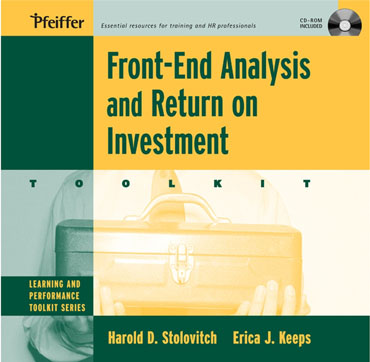 Front-End
Analysis and Return on Investment Toolkit is a comprehensive
collection of guidelines, job aids, rich examples and tips that give readers
the information needed to create performance interventions that will deliver
the desired results. It also includes a robust "plug and play"
CD-ROM that helps users actually derive a bottom-line ROI number. By using
this vital resource you will be able to analyze training requests on the
front end, measure worth and ROI in learning and performance on the back
end, as well as much more.
Front-End
Analysis and Return on Investment Toolkit is a comprehensive
collection of guidelines, job aids, rich examples and tips that give readers
the information needed to create performance interventions that will deliver
the desired results. It also includes a robust "plug and play"
CD-ROM that helps users actually derive a bottom-line ROI number. By using
this vital resource you will be able to analyze training requests on the
front end, measure worth and ROI in learning and performance on the back
end, as well as much more.
 Engineering
Effective Learning Toolkit is a hands-on resource that offers
a systematic, 14-step approach for designing and evaluating successful
training, learning and performance projects. The accompanying CD-ROM includes
easily reproducible and customizable charts and job aids to help you accomplish
each step in the instructional design process.
Engineering
Effective Learning Toolkit is a hands-on resource that offers
a systematic, 14-step approach for designing and evaluating successful
training, learning and performance projects. The accompanying CD-ROM includes
easily reproducible and customizable charts and job aids to help you accomplish
each step in the instructional design process.
Simply visit www.pfeiffer.com and enter promo code W77PS during checkout to receive the discount.

90 World-Class Activities by 90 World-Class Trainers gathers classic activities from ninety master trainers in one convenient place. The stellar list of trainers includes Bellman, Blanchard, Booher, Crum, de Bono, Kouzes, Masie, Pike, Robinson, Scannell, Silberman, Stolovitch, Thiagi, Zenger, and 76 other names you'll know.
Elaine Biech (editor of the Pfeiffer Annuals and author of Training for Dummies) has gathered a powerful and exciting collection of activities from around the globe. The sixteen topics include change management, coaching, diversity, leadership, and teamwork. This invaluable resource presents the favorite activities of some of the most talented trainers in the world—all seven continents are represented.
All of these activities have stood the test of time and are presented here for your use to engage teams and groups in collaborative learning. The contributors provide helpful suggestions for adapting the activities to a particular setting or audience and present ideas for adding zest to their favorite activities to ensure that you are as successful with them as they have been.
The book is filled with experience and expertise. Combined, the contributors have written and edited almost 800 books and over 3,700 articles and have received hundreds of awards. Many are members of the HRD Hall of Fame and they advise some of the largest organizations in the world. Draw on their expertise and implement several of the activities. Your success is guaranteed.
For
more information or to order a copy, click on the cover.

 Workforce
Performance Solutions is
a bi-monthly magazine directed to top-level management, senior human resources,
and workforce and organizational development executives whose task is
to optimize the abilities of their human assets to drive and improve the
execution of enterprise strategy. Harold Stolovitch is the regular "Human
Performance" columnist for Workforce Performance Solutions
magazine. You can read his latest article, "Retention as a Performance
Strategy: A Miracle in Ojai Valley" by
visiting page 16 of the November 2006 digtial edition at http://www.wpsmag.com/digital1106.
For more information on Workforce Performance Solutions, visit
their Website at www.wpsmag.com.
If you have any topics that you would like to see Harold address in his
column, please email him at hstolovitch@hsa-lps.com.
Workforce
Performance Solutions is
a bi-monthly magazine directed to top-level management, senior human resources,
and workforce and organizational development executives whose task is
to optimize the abilities of their human assets to drive and improve the
execution of enterprise strategy. Harold Stolovitch is the regular "Human
Performance" columnist for Workforce Performance Solutions
magazine. You can read his latest article, "Retention as a Performance
Strategy: A Miracle in Ojai Valley" by
visiting page 16 of the November 2006 digtial edition at http://www.wpsmag.com/digital1106.
For more information on Workforce Performance Solutions, visit
their Website at www.wpsmag.com.
If you have any topics that you would like to see Harold address in his
column, please email him at hstolovitch@hsa-lps.com.

Our Guest Author Series
features interesting articles by various professional colleagues. The
latest in our series is by Steven J. Condly, PhD. He is a Research Psychologist
at the University of Central Florida in Orlando, FL. He has studied and
consulted on topics such as incentives use in the workplace, the efficacy
of training, test and assessment design, and human performance improvement.
Currently he is engaged in funded research on recruiting and retaining
math and science teachers, the design of a new class of conceptual computer
science test instruments, and validating a model of factors critical to
successful software adoption. Steven can be reached at scondly@mail.ucf.edu.
Reducing Unwanted Workplace Turnover While Building Performance Success
By Steven J. Condly
 High
rates of employee turnover are a major problem. Money and resources go
into the recruitment and training of personnel. When these same individuals
do not remain on the job long enough for the organization to realize payback
benefit, much of the investment is lost. New employees must constantly
be recruited, the same knowledge and skill sets must be trained, and then
the process repeats itself. A proper understanding of what is behind employee
turnover can assist management to reduce the continuous bleeding of resources
and energy and help improve the overall work environment and organizational
effectiveness.
High
rates of employee turnover are a major problem. Money and resources go
into the recruitment and training of personnel. When these same individuals
do not remain on the job long enough for the organization to realize payback
benefit, much of the investment is lost. New employees must constantly
be recruited, the same knowledge and skill sets must be trained, and then
the process repeats itself. A proper understanding of what is behind employee
turnover can assist management to reduce the continuous bleeding of resources
and energy and help improve the overall work environment and organizational
effectiveness.
Motivation and Turnover
DiPietro and Condly (in press) examined worker retention in the hospitality environment. This is an industry noted for its high employee turnover rates. Rather than investigate specific work and management practices, the researchers took a more theoretical and psychologically scientific approach. Research appears to suggest that turnover is strongly related to worker motivation; "dissatisfied" employees leave whereas "satisfied" or motivated employees remain. DiPietro and Condly discovered that "employee satisfaction" is far less important than specific motivation variables which have been shown to influence thinking and behavior.
Before examining DiPietro and Condly's results, please set aside what appear to be common sense-based, but inaccurate, notions of motivation. Reaching for, and offering, the carrot or the stick may sometimes have a short-term impact on employee motivation. However, far more frequently, such actions result in pitifully small performance improvements. For example, suppose an employee is offered an incentive (the carrot) to raise his or her level of performance to a specified, but very high, level. This employee will most likely be attracted to the incentive, whether it be cash, a travel coupon, or something similar. Unfortunately, the incentive will do very little to convince the employee that he or she is capable of raising his/her performance to the desired level. In similar fashion, offering a threatening speech (the stick) along the lines of: "If you don't improve performance we will have to let you go," also ignores the question of whether said employee is convinced that he/she is capable of performing any better than at the current level. In essence, what we learn is that there is a variety of factors which interact to motivate human thinking and behavior.
Overall, DiPietro and Condly found that a specific grouping of motivation variables were able to explain just over 96% of employee turnover. In other words, there was very good evidence, even with this one sample, that employee turnover is a function of employee motivation. Specifically, the researchers were able to distinguish high- and low-turnover worksites based on their employees' motivational profiles. Low-turnover worksites had employees who, compared to their high-turnover worksite peers, were:
- Efficacious (convinced they had the ability to perform their assigned duties);
- Agentic (convinced that management supported their efforts);
- Emotionally positive about their work and the work environment; and
- Interested in their work (i.e. they have high value for their work).
Additionally, the low-turnover worksite employees reported that they persisted longer and exerted more mental and physical effort in the performance of their duties than did employees in the high-turnover environments.
Of the factors mentioned above, the one which most strongly influenced employee turnover was agency. Even in the face of negative moods or somewhat low levels of efficacy, employees who reported their supervisors to be supportive of them and their efforts were far less likely to leave than were those who felt otherwise.
Recommended Actions
What, then, can a supervisor or the management of an organization do to lower turnover? Here are four specific recommendations in order of their importance as per the results of the study.
First, employees must be convinced that the organizational structure supports and does not oppose them and their efforts. Employees who view "the system" as being onerous, punishing, inauthentic or unreliable eventually leave for greener pastures. Management should concentrate on building supportive structures and on communicating or publicizing the existence of these. (Oddly, employees are often unaware of support structures, as Stolovitch, Clark, and Condly [2001] discovered when they examined the use of incentives to motivate workplace performance.)
Second, management can help build value for work and work processes by connecting what workers do with what they perceive their skill sets to be. Clear avenues of promotion, opportunities for development and advancement, and even occasions of doing other job functions just because they're different (variety being the spice of life) all can help build value for work. Employees who highly value their work and who are possessed of high agency perceptions tend not to leave.
Third, supervisors and managers must arrest perceptions of low efficacy (the belief that one cannot perform one's job tasks). If an employee becomes convinced that he or she is truly incapable of performing as desired, then there is very little reason to stay. Management must encourage employees to believe in their self-efficacy through credible proof (e.g. data; examples).
Finally, supervisors and managers must continuously monitor low levels of the aforementioned motivation factors. They can be spotted by declining persistence and effort expenditures. These are tell-tale signs that employee motivation is waning, and if uncorrected, employee turnover rates will rise.
The good news is that managers can influence employee motivation, often simply and easily by providing feedback that guides employees to perform well and by letting them know when they are being successful. These easy-to-implement actions have demonstrable effects on employee commitment, behavior and the organization's bottom line.
To Conclude
Support worker efforts. Show clearly the value of their work and work accomplishments. Enhance worker beliefs in their ability to perform well. Monitor persistence and effort, accompanied by useful and encouraging feedback. Based on the DiPietro and Condly study, this is a high-probability-of-success formula for reducing unwanted turnover and building performance success valued by all.
References
DiPietro, R. B., & Condly, S. J. (in press). Employee turnover in the hospitality industry: an analysis based on the CANE model of motivation. Journal of Human Resources in Hospitality and Tourism.
Stolovitch, H. D.,
Clark, R. E., & Condly, S. J. (2001). Incentives, motivation, and
workplace performance: research and best practices. Silver Spring,
MD: International Society for Performance Improvement.
We're
always looking for great articles to include in our Guest Author Series.
If you have one that you would like us to consider, please contact
Erica Keeps at ekeeps@hsa-lps.com.

 Are
you a member of ASTD? If you are, stay at the top of your field while
keeping your workplace learning and performance library up-to-date and
housed with the best work being published today. Join the ASTD Book Club
and receive six pre-selected titles a year. For the avid reader to enhance
their skills or for the casual book buyer who is looking for ways to make
their job easier, you will receive incredible savings off the cover price
with the ASTD Book Club.
Are
you a member of ASTD? If you are, stay at the top of your field while
keeping your workplace learning and performance library up-to-date and
housed with the best work being published today. Join the ASTD Book Club
and receive six pre-selected titles a year. For the avid reader to enhance
their skills or for the casual book buyer who is looking for ways to make
their job easier, you will receive incredible savings off the cover price
with the ASTD Book Club.
Harold Stolovitch and Erica Keeps are proud to report that their latest
title, Beyond
Training Ain't Performance Fieldbook, is one of the
first selections.
For more information or to join the ASTD Book Club, go to store.astd.org, log in with your user name and password, hover over Subscriptions, and select ASTD Book Club.

 Do
you have any burning human performance technology questions? Visit the
Ask Harold section of HSA's Website
and ask your questions for Harold Stolovitch to answer. Here is a recent
submission that might intrigue you:
Do
you have any burning human performance technology questions? Visit the
Ask Harold section of HSA's Website
and ask your questions for Harold Stolovitch to answer. Here is a recent
submission that might intrigue you:
Is there a method to determine if an individual's mindset is activity-based versus results-based?
To read the response, visit Ask Harold. To ask your own question, just click on the crystal ball above, fill out the form and click submit.

Click on any of the covers below for more information or to buy copies of our books and learning aids.





For more information on HSA, visit our Website
at www.hsa-lps.com, email us at info@hsa-lps.com
or call us toll free at 1-888-834-9928.If you have any questions or comments, please feel free to contact Samantha Greenhill, Publications and Communications Specialist, at sgreenhill@hsa-lps.com.

To unsubscribe from this Newswire, please reply to this email and put the word UNSUBSCRIBE in the subject line.
© Copyright 2007 Harold D. Stolovitch & Erica J. Keeps