

By Harold D. Stolovitch & Erica J. Keeps
hstolovitch@hsa-lps.com & ekeeps@hsa-lps.com
Why do we so often choose to do the wrong thing even when we know what is right? Several reasons:
- Knowing ain't doing. How is it that we can be part of an ongoing event, know that something is wrong, and still play along? Here are two recent examples from our own experience:
- The
scene: Positronics, a high-tech company, is desperate
to increase comprehensive solution sales. To this end, it has launched
a marketing and sales campaign for its new product, FlexGrowth. As a
client company's needs change and grow, FlexGrowth adapts with them.
The client pays only for what it needs, but Positronics builds in the
potential to scale up, scale down or in any direction the client requires.
Contracting for FlexGrowth doesn't just buy equipment and/or software;
it buys the client adaptive, flexible information technology infrastructure
that seamlessly and effortlessly "flexes" with the needs of
the client. It offers capacity and performance without unnecessary investment,
and it includes strategizing with Positronics on an ongoing basis. It
sounds great, but sales are unimpressive. The company concludes that
more training is needed. The problem: In
our investigations we discovered that the sales representatives were
not very confident that the company could deliver as advertised. FlexGrowth
was not directly integrated into their sales quotas and compensation.
Customers weren't getting the concept. Competition had a sharper-edged
approach. So, what to do? The proposed solution:
After a lengthy survey pointing out all of these problems, and others,
management's decision was to provide more training to the salesforce,
even though every one of them had already been through several iterations
of FlexGrowth training. It hadn't worked before, but conventional wisdom
suggested that we try it again, this time with the admonition to "Do
a better job. Make the training stick!"
- The scene: À la Mode is a retail clothing chain positioned as a buyer's total clothing consultant: "You feel so at home with our clothing consultants that you'll want to return again and again." The problem: Repeat business is down. Management has determined that the main reason is "lack of customer engagement" that should result in a complete quality experience. Whereas the company's proposed solution was training on quality customer engagement, our analysis clearly indicated that the concept of "quality customer engagement" was not universally understood. To some employees (even among management), it meant "a personalized, caring, empathetic, conversation during the sales transaction." To others, it encompassed engagement from the moment a shopper entered the boutique until he or she left it. Another group viewed "customer engagement" as continuing beyond the time spent in the store (via phone calls, emails). Our investigations turned up customer concerns with what they perceived as restrictive sales promotions and a less advantageous frequent-buyer program compared with that of the competition. The proposed solution: Training on quality customer engagement gained consensus, even among the retailer's training team who had demonstrated in a workshop using hypothetical cases that they knew it was not the way to go.
It's oh-so difficult to apply what we know to what we do, often despite concrete data displayed before our eyes. This problem arises numerous times and requires that we work on strategies and tactics to unite our perceptions with our actions - our knowing with our doing.
-
I don't know where to start.
Who are you and how did you get here? People in your position most commonly
come from another field where you were great at what you did. You also
communicated well. Suddenly, you're part of a new team, probably within
the training or human resources development (HRD) group. The expectation
seems to be for you to impart what you know to others. So you train.
But you see that training ain't performance. You hear other people suggest
applying other interventions. But which ones? And how? Or maybe you
are a training professional and you're good at it. How do you step beyond
the training arena? How do you avoid traipsing into other professionals'
territories (for example, human resources, organizational development,
organizational effectiveness, or management)? Excellent questions. And
in both or other cases, you may be wondering what gives you the right
to step in and say "no" to what your supervisors or clients
believe should be done. What's your authority? Where do you begin? Once
again, these are highly relevant questions and concerns.
Many people have been in the same position as you, raising the same perplexing issues. The short answer to all of these questions is that you have one mission: to help your clients (the direct-contact people with whom you work) and your organization achieve results they value. How you do it is the challenge. Fortunately, a growing knowledge base, rich literature and professional societies such as ISPI (International Society for Performance Improvement) are there to assist. (Visit www.ispi.org for publications, conferences, and professional development.)
- Is
this something I can do on my own?
Probably not alone. You can - and we sincerely hope will - be a key
driver and catalyst for transforming the organization from a training-fixated
entity to one that understands the difference between virtuous activity
and bottom-line results. And through your efforts, your insight, and
especially the data you gather, you can help build a team to make it
happen.
- What do I do to bring others aboard? By sharing ideas, cases, and successes, and by easing your colleagues and clients into a new mode of thinking, you gain allies. Remember, there are those who can help. (You can always contact us at info@hsa-lps.com.) Know that your work will be so much easier as you gain credibility, trust, momentum, and demonstrable performance results.Your challenge - and, in a sense, your mission - is to demonstrate the value of this training-to-performance transformation to:
- your own managers, by achieving bottom-line results (such as higher payoff, lower costs, improved customer satisfaction)
- your colleagues, by displaying greater impact, credibility, professional growth, and job satisfaction
- your clients, by focusing on their issues in a rigorous, data-based manner that solves their problems in ways they value (for example, decreased error rates, increased productivity, rapid implementation of new systems, and decreased turnover)
- your organization, by producing more thorough analyses and systemic, integrated solutions, and by achieving business objectives and goals complete with data-based evidence.
As you experience successes, interest will grow and more people will hop aboard the performance train. It ain't always easy, but it can be done!

This article is an excerpt from Harold Stolovitch and Erica Keeps' bestseller,
Beyond Training Ain't Performance Fieldbook.
Interested in learning more? Click here
to order a copy of the book.

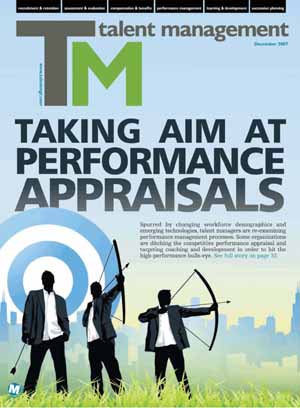 Talent
Management is a monthly magazine directed to top-level management,
senior human resources, and workforce and organizational development executives
whose task is to optimize the abilities of their human assets to drive
and improve the execution of enterprise strategy. Harold Stolovitch is
the regular "Human Performance" columnist for Talent Management
magazine. You can read his latest article, "Physical Environment
Impacts Workplace Performance" by
visiting page 12 of the December 2007 digtial edition at http://www.talentmgt.com/digital1207.
For more information on Talent Management, visit their Website
at www.talentmgt.com.
If there are any topics that you would like Harold to address in his column,
please email him at hstolovitch@hsa-lps.com.
Talent
Management is a monthly magazine directed to top-level management,
senior human resources, and workforce and organizational development executives
whose task is to optimize the abilities of their human assets to drive
and improve the execution of enterprise strategy. Harold Stolovitch is
the regular "Human Performance" columnist for Talent Management
magazine. You can read his latest article, "Physical Environment
Impacts Workplace Performance" by
visiting page 12 of the December 2007 digtial edition at http://www.talentmgt.com/digital1207.
For more information on Talent Management, visit their Website
at www.talentmgt.com.
If there are any topics that you would like Harold to address in his column,
please email him at hstolovitch@hsa-lps.com.

 This
past autumn Harold and Erica took their first in a series of river cruises.
They traveled from Budapest down the Blue Danube visiting small villages
and large cities in Slovakia, Austria and Germany along the way. The tour
ended in the beautiful city of Prague. Pictured at left with Erica and
Harold are Swiss Diamond riverboat crewmembers.
This
past autumn Harold and Erica took their first in a series of river cruises.
They traveled from Budapest down the Blue Danube visiting small villages
and large cities in Slovakia, Austria and Germany along the way. The tour
ended in the beautiful city of Prague. Pictured at left with Erica and
Harold are Swiss Diamond riverboat crewmembers.
Pictured at right are some of the group at an authentic Czech restaurant
in Prague. The food and service were great!
If you are interested in traveling with Harold and Erica in 2008, watch for articles in upcoming editions of HSA e-Xpress as well as notices. You can also let us know of your interest in cruising on your contact sheet when you visit our website www.hsa-lps.com. Or pick up the phone and give Erica a call and ask what's on deck!

Our Guest Author Series
features articles by various professional colleagues. The latest in our
series is by Dr. Sylvie Vanasse. Sylvie is the Director of People for
Parsons Brinckerhoff Australia. She can be reached by email at svanasse@pb.com.au.
Ten Strategies to Develop Leaders in a Technical World
By Dr. Sylvie Vanasse
The Challenges for Technical Leaders
According to recent research conducted by the Boston Consulting Group (BCG), leaders will increasingly be expected to possess deep industry or functional expertise along with advanced communication, team-building and workforce management skills. This means that successful leaders in professional consulting firms will be required to be highly flexible and vary their management styles to adapt to an increasingly diverse and multi-generational workforce while remaining technically credible with their clients.
Where do leaders acquire such skills? Leadership and management skills are superficially, if at all, covered in technical university curricula. As a result, the industry relies on organizations to fill in the gaps.
The following ten human performance technology (HPT) strategies were implemented to help develop leaders and minimise the loss of talented employees within their organisation.
Ten HPT Strategies to Develop Technical Leaders
1.
Make people development one of your top three business priorities
High-performing businesses assign people development as one of their top
three business priorities (McKinsey, 2001; Hewitt 2003). This is even
more frequently done in people businesses, such as professional
consulting firms. McKinsey claims that good leaders spend at least 35%
of their time on people matters. Jack Welch, the famous CEO of General
Electric, attributed this practice to his success.
2. Create a culture that fosters positive relationships
between employees and leaders
Culture can be defined as "the way we do things around here."
This way should be fostering employee-manager intimacy, i.e., supportive,
based on coaching and continuous and candid feedback.
Culture is underpinned by values. However, the values must be genuine. Otherwise, they can backfire and bring about disenchantment from employees. All leaders, in particular senior managers, must be seen to live the values and act as role models.
3.
Role-model good management practices
Leaders will do to their employees what is done to them. Without the most
senior leaders of the organization modelling good management practices,
there is little hope of these being perpetuated by middle and, even less,
by frontline leaders. This principle is well-known, yet senior leaders
are often blind to their own behaviours.
4.
Provide continuous feedback
Unless they have participated in a number of 360 degree feedback or assessment
exercises, most leaders have blind spots with regard to their leadership
and management styles. Providing constructive feedback using reliable,
anonymous and proven tools is critical to raise leaders' self-awareness
and guide their subsequent development. Leaders who receive regular feedback
tend to do the same with their direct reports, thus strengthening employee-leader
relationships.
5.
Put in place people metrics and targets
Organizations measure and track what is important. If people management
is important for your enterprise, then measure it. BCG, itself one the
top 10 world-wide employers of choice, claims that for people businesses,
reporting on the value that individuals bring to the business makes more
sense then only reporting on financial and physical assets.
Appropriate metrics can include employee retention, productivity, results of employee engagement/culture surveys, and results of leadership competency assessment. Management data gathered must also translate into actions to bring about improvements.
6.
Develop incentives and recognition programs that reinforce desired behaviours
Establish an incentive scheme aligned with your measures and appropriately
reward top achievers. Some people businesses consider only two primary
sets of metrics for their leaders: business performance and people management.
This means 50% of their leaders' bonuses are related to people management.
How much is it in your organisation? Are your incentives mainly focusing
on business performance? If so, your balance may be wrong.
7.
Provide foundation leadership and management education
Most technical professionals have received very little leadership and
management education. Even though educational programs, especially traditional
classroom-based programs, may not dramatically transform individuals,
they provide a platform for sharing experiences and helping them gain
insights into staff motivations. According to an IBM study, companies
that have 80% of their middle managers enrolled in leadership development
programs enjoy three times the profitability of those companies with less
than 60% of managers on such programs.
8.
Recruite the right people in the first place
Historically, in the technical world, the primary hiring criteria for
leaders are related to technical expertise. Given the challenges discussed
above, this is no longer sufficient. Selection criteria should take into
consideration an individual's leadership capabilities as well as technical
expertise. According to the Corporate Leadership Council, individuals
with strong technical abilities and who are deemed high performers but
who display low level of leadership aspiration, have only a 44% chance
of success when promoted.
9.
Promote from within
Conduct high-potential and succession planning programs to identify and
promote future leaders from within the organization. A study conducted
by the firm Development Dimensions International (DDI) claims that strong
leadership development and succession planning lead to increases of 20%
in financial performance, 14% in employee satisfaction and 17% in retention
of quality employees.
10.
Weed out poor leaders
In their book The War for Talent, the McKinsey partners are very
clear; if you want dramatic results in the shortest possible time frame,
identify your top leaders and recognize them generously. Re-assign or
weed out the others. Some individuals have skill deficiencies or personal
attributes that cannot be realigned to the organisation's values and goals.
Examples of such skills and attributes include poor interpersonal skills,
overconfidence and arrogance.
Conclusion
Leaders in the technical world often enter the workforce with underdeveloped management skills, leaving organizations with the task of overcoming their development gaps. A number of strategies can be adopted by organizations to help develop technical leaders. These should include a number of human performance improvement solutions such as: business prioritization and measurement, culture, career development, succession planning and individual recognition. They are building blocks that reinforce one another.
Do
you have an article that you would like us to consider including in our
Guest Author Series? It can be new or previously published. If so, please
contact
Erica Keeps at ekeeps@hsa-lps.com.

Harold Stolovitch will be presenting a keynote address at the Talent Management magazine event: Strategies 2008: Perspectives on Managing People on May 5 in Scottsdale, AZ. Click here to view HSA's Events Calendar to learn where and when Harold will be speaking as well as to read session descriptions.
 Due to popular demand, Harold will be the principal speaker and facilitator
at ASTD's Telling Ain't Training Mini-Conference on October 21 & 22
in Chicago, IL and on November 6 & 7 in Washington, DC. Click here
for more information.
Due to popular demand, Harold will be the principal speaker and facilitator
at ASTD's Telling Ain't Training Mini-Conference on October 21 & 22
in Chicago, IL and on November 6 & 7 in Washington, DC. Click here
for more information.

 Do
you have any burning Human Performance Technology questions? Visit the
Ask Harold section of HSA's Website
and ask your questions for Harold Stolovitch to answer. Here is a recent
submission that might intrigue you:
Do
you have any burning Human Performance Technology questions? Visit the
Ask Harold section of HSA's Website
and ask your questions for Harold Stolovitch to answer. Here is a recent
submission that might intrigue you:
I'm putting together a pre-test and post-test for one of our training programs. It will be given to some, but not all of the participants to determine if the participant knowledge increased as a result of the training. Since the training we do is not based on clear, measurable objectives, the only test I can create is a knowledge test of the content that is covered. Do you have any information on when a pre- and post-test is effective and when it is not?
To read the response, visit Ask Harold. To ask your own question, just click on the crystal ball above, fill out the form and click submit.

Click on any of the covers below for more information or to purchase copies of our books and learning aids.






For more information on HSA, visit our Website
at www.hsa-lps.com, email us at info@hsa-lps.com
or call us toll free at 1-888-834-9928.If you have any questions or comments, please feel free to contact Samantha Greenhill, Publications and Communications Specialist, at sgreenhill@hsa-lps.com.

To unsubscribe from this Newswire, please reply to this email and put the word UNSUBSCRIBE in the subject line.
© Copyright 2008 Harold D. Stolovitch & Erica J. Keeps