You
can access HSA's Website at www.hsa-lps.com or
contact us directly at info@hsa-lps.com or toll free at 1-888-834-9928.
Human Performance Predictions for the Decade Revisited
By Harold D. Stolovitch
hstolovitch@hsa-lps.com
In 1999, I completed two "best practices" studies on learning and performance. One focused on technology-based interventions. The other examined information we gathered from over 400 companies on training investments, strategies and performance support successes. From both I extracted human performance improvement trends.
What emerged from the studies and literature reviews was a simple conclusion: fundamentals, not fads, were the keys to success. Leading, successful companies in terms of market share, revenues, profitability and share value were more committed to learning and human performance improvement than other less successful ones. Helping people learn and perform was a key strategy for their business successes.
A second finding from the studies was that no one company had it all - did everything right. However, I discovered that the leaders tried harder and actively sought to expand their repertoire of performance improvement capabilities.
Based on the work I had just completed, I wrote a brief article offering ten predictions of what was likely to transpire in workplace learning and performance over the next ten years. Today, we revisit year 2000 predictions to determine what has transpired since then.
Ten Predictions 2000 - 2010
The article opened as follows: "Don't expect amazing miracles to dramatically transform human learning and performance just because we are on the threshold of Y2K. Rather, look for what we have already learned about performance improvement to become increasingly refined and applied in the workplace."
1999 was a heady year. The dot-com bubble had not yet burst. Optimism was in the air. The devastation following the dot-com implosion and the current depressed economy were nowhere on the horizon. The belief that technology was the key to progress was all-pervasive. With all that has gone on since then, I believe that the opening general prediction was accurate. Since 2000, our human performance improvement practices have advanced by degree far more than by revolutionary innovation. Now for the specific predictions.
- Clear
understanding of uses and limitations of technology-based learning (TBL).
I would substitute the word "better" for "clear."
TBL has become integrated into the array of strategies we currently
apply in the workplace. Over the past three years, e-learning has settled
in at approximately 30% of training delivery. Electronic Performance
Support Systems (EPSS) and Knowledge Management (KM) made dramatic entrances
then quietly settled in. The Web is an increased presence, but has not
wildly altered things - except in the degree and naturalness of use.
Twitter, blogs, RSS and social networking are present, but marginally
used in workplace performance. Podcasts are popular, but so were audiocassettes.
- General
commitment to front-end analysis before launching into training ventures.
Sadly, not
much is happening here. There is more "awareness" of the need
to conduct performance gap analyses, but not much evidence of "ready"
and "aim" before "fire."
- High
demand for soundly engineered learning systems, courses and materials
rather than cobbled-together info dumps.
The past two years, with enormous cost-cutting and lay-offs, have seen
most signs of early progress retreating. Speed of development and delivery
rules. Not much has changed here since 2000.
- High
demand for evidence that training and other performance interventions
work - emphasis on demonstrated ROI. The
rhetoric has certainly increased. Human Capital Management (HCM) and
Human Capital Analysis (HCA) have appeared. There is considerable interest
in ROI, but when organizations are asked what they are doing about this,
few concrete examples emerge. I anticipate that the pressure building
to demonstrate the value in workplace learning and performance will
result in more front-end analyses and impact ROI measurement within
the next two years.
- Rediscovery
of the value of live, interactive learning events. Live
events - face-to-face or online - have experienced resurgence in popularity
and respect. About 70% of all learning events to improve performance
are live and synchronous. The concept of blended solutions generally
includes "live learning."
- Conscious,
clear understanding of the value of human capital. Underlying
talent management - a concept born of this decade - is the demonstrable
value human capital offers. HCM and HCA frequently appear in publications.
HCM measurement has become highly sophisticated.
- Deeper
understanding of learning organization, corporate university, knowledge
management and reusable learning objects. All
of these concepts have evolved over the past ten years. From trendy
idea to deeper structural meaning, each has become absorbed into the
mainstream of organizational life. Almost all modern organizations have
built learning networks, from individual to teams to industry-wide communities,
of mutual learning and support. Corporate universities now include abstracts
beyond courses and curricula. KM no longer is symbolized by expensive
IT systems but is carried on through myriad channels. RLOs are far more
nuanced than the naïve mottled notions of building courses by numbers.
- Larger
numbers of partnerships between internal and external groups for improving
human performance.
Despite cutbacks on outsourcing of services, the trendline is upward.
External expertise in learning and performance is brought in to work
with internal specialists to obtain high quality, rapid interventions.
The dollar data, although recently flattened, indicate increased use
of external resources.
- Transformation
of training groups to human performance support services.
The title of Performance Consultant (PC) is much more common today than
in 2000. Most large enterprises no longer have "training"
groups. Learning and development, learning and performance, and performance
enhancement appear regularly in organizational directories.
- Emergence of human performance technology as a major, influencing field for achieving workplace and societal goals. "Emergence"…yes as the 21st century advances. "Major influencing field"…still a distant dream. Nevertheless, there is progress as witnessed by the growth of university programs, publications and numbers of performance professionals.
Human Performance 2010, as predicted, is stronger and more present than it was in 2000. It is becoming "increasingly refined and applied in the workplace." Now let's look ahead to 2020 and what the next decade will bring. Whither 2020?
Telling Ain't Training Goes Global - Dutch Treat
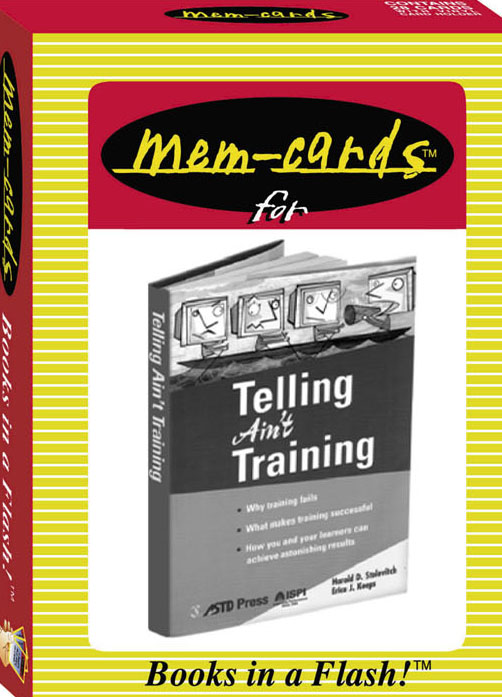
Telling Ain't Training, ASTD Press' best selling book ever, is now available in Dutch. The book is called Vertellen Is Nog Geen Trainen and is published by Van Duuren Media, who publish under the imprint Van Durren Management. Dutch magazine, M&L, recently interviewed and photographed the authors, Harold Stolovitch and Erica Keeps, at their Playa Vista, CA writers' retreat.
When the interviewer asked what the best compliment and most common criticism of Telling Ain't Training has been, Erica and Harold responded in their typical frank manner.
Best Compliment: The language, format and style are breezy and very accessible. Relatively jargon-free, Telling Ain't Training can be enjoyed by novices and professionals alike. Readers share with us the successes they have enjoyed implementing the principles and practices in their organizations. That's the best compliment of all! We are frequently invited to participate in Telling Ain't Training study groups in companies and universities.
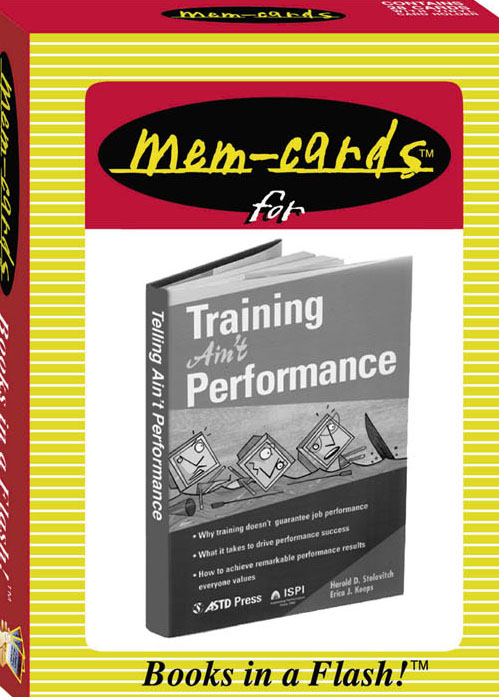
Most Common Criticism: Not exactly a criticism, more of a request: Give us more! We need practical ways to transform our training teams and organizations. We want tools, templates, shaping exercises, etc. This led to a rethinking of Telling Ain't Training's potential and impacted the emergence of Beyond Telling Ain't Training Fieldbook. Readers also were eager for the other half of the story which gave rise to Training Ain't Performance and its Beyond Training Ain't Performance Fieldbook.
Haven't read Telling Ain't Training yet? Want to learn more or order a copy? Visit http://hsa-lps.com/To%20order.htm#TAT.
How Are You Using Telling Ain't Training?
We were recently contacted by a couple of Telling Ain't Training readers who let us know how the book is being used in their organizations:
I
wanted to let you know how your book, Telling
Ain't Training, has positively transformed a company's training program
and me!
I was approached two years ago about taking a company training team "to
the next level." I was given wide latitude on how to do this and
complete creative control. After reviewing too many publications on training,
I happened upon Telling Ain't Training and was instantly hooked.
I used your book as a basis for a program I call Prepare to Train. In
our first session each participant is instructed to "train"
us on a topic of their choice, with no additional constraints or suggestions.
Then each participant (and there have been 70+ to date) was given a copy
of your book. (Believe me, we have kept Barnes and Noble busy!) The next
three sessions were then spent discussing (participant-led discussion)
on your book and how it applied to our professional, and sometimes private,
lives. Additionally, their original "training" session was discussed
on what could have done better/different/etc. During our last session,
each participant selected one activity from your 25 Training Activities
list and delivered it to the group.
They have used their new skills to create a technical training program
using the principles from Telling Ain't Training and, of course,
the Training Session Planning Sheet. They retrofit another training program
and are currently in the process of creating another new training program.
The exciting part has been the comments from the new hires that have gone
through the training - "it's so organized," "it's so easy
to understand," "this is the best training I've ever been through,"
etc. The most incredible part is the feedback from the current staff concerning
the high level of the new hires after training and also the fact that
the current employees are so intrigued with the new training; they want
to go through it themselves!
Thank you for such an enlightening, easy to understand, transformational
book!
- Pam Sullivan, Charlottesville, VA
I have just finished reading your book Telling Ain't Training and I wanted to drop you a note to commend you on an excellent book. I have been reviewing considerable literature for the past few years and I think your publication is one of the clearest, straightforward publications I have come across in a long time. I am recommending that everyone in our training organization review it as it serves as a great tool to "bring everything together."
- Steve Sniderman, Amway
Click here to read more Telling Ain't Training reviews.
Loved Telling Ain't Training? Go the next step and bring Telling Ain't Training live and in-house to your organization! Visit http://hsa-lps.com/Seminars.htm to learn more about Telling Ain't Training workshops and Training Ain't Performance ones as well.
Talent Management Columnist
Talent Management is a monthly magazine directed to top-level management, senior human resources and workforce and organizational development executives whose task is to optimize the abilities of their human assets to drive and improve the execution of enterprise strategy.
Harold Stolovitch is the regular "Human Performance" columnist for Talent Management magazine. You can read his latest article, "Human Performance 2000-2010" by visiting page 10 of the January 2010 digtial edition at http://www.nxtbook.com/nxtbooks/mediatec/tm0110/#/12. For more information on Talent Management, visit their Website at www.talentmgt.com. If there are any topics that you would like Harold to address in his column, please email him at hstolovitch@hsa-lps.com.
Guest Author Series
Our Guest Author Series
features articles by various professional colleagues. The latest in our
series is an excerpt from Stepping UP: A Road Map for New Supervisors
(http://ca.pfeiffer.com/WileyCDA/PfeifferTitle/productCd-0787987158.html)
by co-author Miki Lane, CPT. Miki is the founder of MVM Communications
(www.mvmcommunications.com)
and a specialist in human performance improvement and instructional technology.
He can be reached at mml@mvmcommunications.com.
The Performance Model (An Excerpt From Stepping UP: A Road Map for New Supervisors)
By Miki Lane
Managing the performance of your team members is your primary responsibility. The performance equation and the managing performance model introduced in this module will help you understand the performance of your team members and identify the actions you can take to support excellent performance.
The
impact of employee performance on company success
Recent research by the Conference Board of Canada and others shows a strong
link connecting employee satisfaction, customer retention, and profitability.
The Gallup Company recently released findings from a multi-year study of the relationship between company success (measured in terms of revenue, profitability, customer loyalty, and employee retention) and the presence of specific workplace conditions. The study surveyed more than 100,000 team members, in 2,500 company units and 12 industries. The following employee statements were closely linked with company success:
- I know what is expected of me at work.
- I have the materials and equipment I need to do my assignment right.
- I have the opportunity to do what I do best every day.
- I frequently receive recognition or praise for doing good work.
- My team leader, or someone at work, seems to care about me as a person.
- In the past six months, someone has talked to me about my progress.
- I contribute to
setting my work priorities.
- I know how my assignment
contributes to the goals and purpose of my company.
- My fellow team members are committed to doing quality work.
Each of these statements is linked to one of the three factors in the performance equation. Interestingly, if you go farther back in the literature review, you will find that these statements are derived from Tom Gilbert's Behaviour Engineering Model, in which he looked at determining the causes for performance gaps.
The
performance equation
Employee performance is a function of three critical factors:
- Clear expectations
- Ability
- Willingness
These three factors must be present for an employee to achieve the expected results. This reality is expressed in the performance equation shown here.
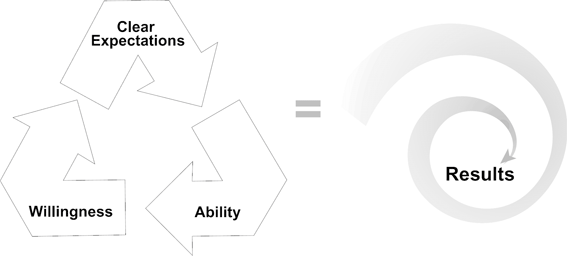
The manager's primary function is to manage these three factors in order to help employees produce results.
Clear
expectations - "I know"
Clear expectations mean an employee has an understanding of expected results
and what these results should look like.
Clear expectations also mean the employee knows why he or she is doing a particular assignment.
Having clear expectations allows the employee to take action within mutually defined limits and guidelines. It helps both manager and employee track progress towards the achievement of strategically important objectives.
Ability
- "I can"
Employees must have the required knowledge, skills, and experience in
order to perform an assignment. They must also have the necessary resources
(materials, training, documentation) and the appropriate environment (information,
authority, opportunity to learn and practice). This also means that there
must not be any obstacles or hindrances to performing the assignment as
expected.
Willingness
- "I want to"
Generally speaking, people will achieve expected results when they want
to. While a manager can't motivate an employee to perform, you can create
and sustain an environment in which employees want to succeed.
Willingness is created when a person is challenged by high expectations, is encouraged to contribute ideas and suggestions, has opportunities to develop new assignment skills, and receives recognition for his or her efforts.
The
performance model
For an employee to achieve expected results, the three factors (clear
expectations, ability, and willingness) must be in place.
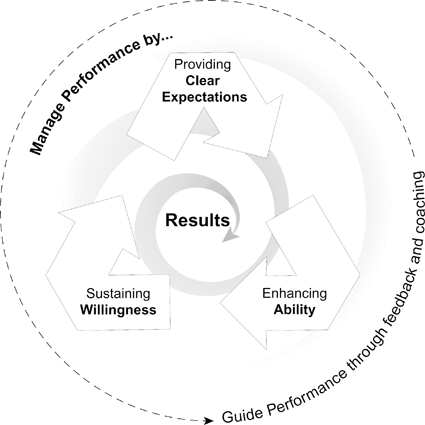
To keep these factors in place, the manager must consistently get and give feedback, and provide coaching when required.
How
to Use the Model
As many of us have learned from Gilbert and from our own experiences,
a manager's job is to make available everything an employee needs to
successfully perform a job and produce results. The Supervisory Performance
Model shows this on two levels:
-
Managing performance by providing the three elements of the equation when the employee takes on the job and at performance appraisal time thereafter.
-
Guiding performance with daily dialogue, feedback, and coaching specific to immediate goals and needs.
The Model reminds us to:
-
Provide clear expectations that include results described in terms of a measurable output that contributes to a larger goal.
-
Enhance the employee's ability by ensuring the person has the required knowledge and skills, tools, and resources, and a supportive work environment in which to succeed.
-
Sustain employee willingness by setting high expectations, giving encouragement, providing opportunities for learning, and recognizing results in ways meaningful to each individual.
Success
Story
MVM has used this model in a variety of programs with a number of different
clients. They report that supervisors have seen a positive difference
in the long-term performance of their direct reports that has helped
their organizations better meet their business goals. A bonus: the turnover
rate of new supervisors has dropped from 40% in the first 18 months
to less than 20% with these clients.
Advice
to Users of the Supervisory Performance Model
The Model is best included in a program specifically designed for new
to almost-new supervisors as well as for prospective supervisors who
want to know more about their potential responsibilities. The Model
can also be used as a coaching or diagnostic aid for a manager working
with a struggling supervisor. It could also be used as the foundation
on which to construct a successful supervisory/management program.
Application
Exercise
To put the Supervisory Performance Model to work, use the elements to
check the structure of supervisory programs you work with to be sure
the critical pieces are addressed. Then, consider using Gilbert's six
cells to construct a complete program that: sets expectations, provides
tools and resources, builds in meaningful incentives, addresses consequences,
necessary skills and knowledge, and the selection of the right people
for the right jobs.
Have
you written an article that you would like us to include in our Guest
Author Series?
It can be new or previously published. Please contact Erica Keeps
at ekeeps@hsa-lps.com
for more information.
Congratulations
We would like to congratulate our Publications and Communications Specialist, Samantha Greenhill and her husband, David Luchuk on the adoption of their son, Adam. Samantha and David recently made a trip to Seoul, Korea where they were united with their much anticipated baby boy. After a 26-hour journey, the three finally settled into their home in Montreal, Canada. Adam has thrived since joining his parents only a month ago. He is a very happy, loving and curious little boy. We wish only the best for them.
Upcoming Events Featuring Harold Stolovitch
Here's where Harold Stolovitch will be presenting in the near future:
- ASTD Telling Ain't Training...And More... - March 15 & 16, 2010 in Las Vegas, NV
- ASTD Telling Ain't Training...And More... - October 12 & 13, 2010 in Arlington, VA
- ASTD Telling Ain't Training...And More... - October 14 & 15, 2010 in Atlanta, GA
Visit https://www.hsa-lps.com/Events_Summary.htm to view HSA's Events Calendar to learn where and when Harold will be speaking as well as to read session descriptions.
Ask Harold
Do you have any burning Human Performance Technology questions? Visit the Ask Harold section of HSA's Website and ask your questions for Harold Stolovitch to answer. Here is a recent submission that might intrigue you:
You were referred to in a webinar I attended as a source in stating that only around 30% of know-how and skills contribute to improvements on performance. This being the case, what are the other factors that make up the other 70% and where may I find this reference? Is it contained in your research or in a publication?
To read the response, visit http://hsa-lps.com/Expert_Q_A.htm#reference. To ask your own question, visit https://www.hsa-lps.com/Expert_Q_A.htm and fill out the form at the bottom.
Publications & Learning Aids
For more information
or to purcahse copies of our books and learning aids, visit https://www.hsa-lps.com/To%20order.htm.
If you have any questions or comments, please feel free to contact Samantha Greenhill, Publications and Communications Specialist, at sgreenhill@hsa-lps.com.
To unsubscribe from this Newswire, please reply to this email and put the word UNSUBSCRIBE in the subject line.
© Copyright 2010 Harold D. Stolovitch & Erica J. Keeps