
By Erica J. Keeps & Harold D. Stolovitch
ekeeps@hsa-lps.com & hstolovitch@hsa-lps.com
 In
this brief article, we will address two key areas for performance consulting
success: building credibility and trust and building partnerships.
In
this brief article, we will address two key areas for performance consulting
success: building credibility and trust and building partnerships.
Building Credibility and Trust
Your title includes the word "training" and/or your group is called "training." Why then should anyone believe that you do anything other than training? You have evolved. How do you get your clients to evolve with you?
The answer, fortunately is relatively simple. Before making the grand announcement that you or your group has become the "learning and performance support" organization, build credibility and trust with clients and stakeholders. Here are six steps that others have taken to achieve success.
- Find a friendly, open client who is very much focused on performance and who has a situation that offers a high probability of success. Go for something relatively simple and certain to result in clear performance improvements. It should be one that requires more than one intervention other than training. Partner with the client. Establish bottom line metrics - key performance indicators that you can measure. Conduct your analysis, identify, develop and help implement the interventions. Monitor results. Collect data. Write up the case.
- Conduct "show and tell" events. Hold a free lunch to which you invite clients and other influential persons. During the lunch, show success stories. Have the client or clients with whom you have had success do much of the presenting. Demonstrate with data, the value of your performance approach.
- Circulate information about the new services you offer and invite inquiries. Just as external vendors do, market your expanded repertoire of services. Create a brochure or an e-brochure. Circulate brief articles that support your approach. (ISPI and ASTD publications are excellent sources). Write up success stories for internal newsletters. Share authorship with your clients.
- Offer to participate in business initiatives that will require performance change before you are asked to provide training. Get there early so that you can act strategically to influence decisions before they are imposed on you. Offer a unique perspective on people performance.
- Build your competencies. Evaluate your current and desired competencies. Create development programs and activities that will carry you and your team beyond training to performance.
- Change your department name and/or job title. Obtain champion assistance and work with your group to create a new title and image that fits your new mission. Include "performance" in it.
Building Partnerships
To achieve performance success for yourself and your team, you must create powerful partnerships. The three critical ones are with clients, internal others and external others.
Client partnerships. This partnership is the most crucial for success. Clients often view training groups as order takers. "Here's my problem. Now fix it with training." Your new mission requires that you let your clients know:
- You can do more for them than just training.
- You can add much greater value and probably save money and time, if you are permitted to work "with" rather than "for" them.
- You care about their overall business success and want to share in the challenge and responsibility.
Take a client to lunch. Discuss his or her issues. Speak the client's language (i.e., business not training). Demonstrate your desire and capability to be a partner in the effort and outcome. Underscore the key benefits: focus on their performance (not just learning) needs; sharing of expertise; possible time and cost savings; measured results; on-going support; shared responsibility in the effort and results.
Developing deep, lasting client partnerships takes time and must be continuously renewed. These partnerships should be long-term. The rewards for this type of relationship are many: higher probability of making significant, demonstrable contributions to client and business success; earlier involvement in projects; richer basket of interventions; greater respect and status; stronger influence on what counts; career development and growth.
Partnerships with internal others. Achieving performance success requires the assistance, collaboration and support of many persons and groups outside of your own. Here is a partial list of potential partners: organizational development (OD) specialists; organizational effectiveness (OE) specialists; information technology (IT) groups; evaluation specialists; communication groups; ergonomics specialists; media specialists; financial experts; content specialists. Depending on projects, it is very useful to be able to call on these diverse internal resources to add depth to what you are trying to accomplish for your clients. What's in it for these internal partners is a break from the routine, a chance to make unique and impactful contributions, an opportunity to learn something new and to gain recognition for their contributions. At some future time, they can also call on this internal partner network for assistance. Their support in your venture can only enhance your credibility, trust and success.
Partnerships
with external others.
Successful learning and performance support groups build banks of trusted,
reliable outside partner-providers who can come aboard quickly and seamlessly
to join in performance improvement projects. You seek out quality providers,
verify capabilities and place them in a preferred database. The benefits
of creating these external partnerships are: rapid learning curve; proven
capability; trusted relationship; seamless integration with you and your
team; a cost only when used. These partners, generally highly expert in
their own areas of performance improvement, add to your own performance
success. You can also learn a great deal from them. Usual external partners
include: performance analysts; intervention design and development specialists
(e.g., compensation; human factors; workflow design); media and technology
specialists; evaluation specialists.
This article is based on Harold Stolovitch and Erica Keeps' newly released book, Training Ain't Performance. This book provides valuable skill development and includes a rich set of resources for further study. To learn more about Training Ain't Performance, click here.

By Harold D. Stolovitch & Erica J. Keeps
hstolovitch@hsa-lps.com & ekeeps@hsa-lps.com
 An
important influence for successful learning is metacognition - the set
of higher-level (meta = above) control processes that guide our deliberate
information processing activities. These executive-level processes come
into play any time we set mental or cognitive goals for ourselves, such
as learning or solving a problem, and then attempt to meet them in an
efficient way. We develop skill in using these higher-level processes
at a very young age and continue to improve them as we learn how to learn.
An
important influence for successful learning is metacognition - the set
of higher-level (meta = above) control processes that guide our deliberate
information processing activities. These executive-level processes come
into play any time we set mental or cognitive goals for ourselves, such
as learning or solving a problem, and then attempt to meet them in an
efficient way. We develop skill in using these higher-level processes
at a very young age and continue to improve them as we learn how to learn.
Why Metacognitive Skills are Important
Picture yourself wandering in a forest, alone and starving. You're desperate to eat. As you enter a clearing, you spot a chunk of food. Your mouth waters. But before you can make a move, a tall, muscular, mean-looking person steps into the clearing, growls, and hungrily lunges for the food. Cooperation obviously won't work here. It's survival of the fittest. Who will be the survivor? The rough and tough big brute or you?
Nature has dealt you and "Brutus" different physiques. He is genetically gifted with great size, powerful musculature and raw force. You aren't. Who do you think is most likely to win? Place your bets on the outcome.
Hold it! What if you are smaller and less muscled but have tremendous skill in the martial arts? Does that change the probability of your success? Will you consider changing your bet?
Although not exactly perfect, the analogy of raw ability to learn and well-developed metacognitive skills with size/musculature and martial arts skills illustrates the importance of highly developed executive-level thinking and planning capabilities. Studies conducted to examine the major differences between excellent and poor learners have highlighted the importance of metacognitive skills to establish learning goals, plan for them, execute them and achieve positive results. The more unfamiliar the learning or problem to solve, the more beneficial well-developed metacognitive skills become. Research has demonstrated that, despite equal intelligence or subjects, variations in metacognitive skills lead to greater or lesser success in learning.
What are these metacognitive skills? Researchers and authors describe them in different ways. We find Richard Clark's (1998) descriptions of five such skills and how they operate to a greater or lesser degree in good and poor learners to be very helpful. Clark's descriptions are paraphrased and summarized in the table below.
Metacognitive
Skills in Good and Poor Learners
|
Metacognitive
Skill
|
Good
Learner
|
Poor
Learner
|
|
Planning
|
Faced with new learning, reasons out what must be done, creates a plan to accomplish the learning and organizes time and resources appropriately. | Faced with new learning, doesn't know what to do. Randomly tries various approaches without prior planning. Uses whatever comes to mind and muddles through. Applies what has been used before, whether or not it worked or even fits the new learning challenge. |
|
Selecting
|
Looks, listens, studies, analyzes and sifts through the chaos to identify critical and focal elements of the new material. Separates the wheat from the chaff. | Doesn't know where to turn. Everything is important; everything has to be learned. Is soon overwhelmed by the flood of new information and is drowned in the details. May make inappropriate or trivial selections. |
|
Connecting
|
Continuously seeks to build linkages with prior knowledge. Attempts to understand the new content and link it with what is already known. Creates personally meaningful analogies and mnemonics. | Views the new content as a mass to be digested and attempts to memorize it without linkages to known skills and knowledge. Isolates the new learning from previous experience and does not make useful connections with what has been mastered previously. May create erroneous or false analogies. |
|
Tuning
|
As new information is received and the learner practices with it, he or she brings the new knowledge into sharper and clearer focus. Adjusts analogies and mental images to coincide more accurately with new learning. Discards erroneous assumptions or early helpful learning crutches that are no longer required. | Obtains a fuzzy understanding of the new learning, but cannot bring it into focus. Continues to add more information rather than to test, adjust and eliminate. Cannot create a clear picture of the new knowledge and skills and thus makes errors or applies the new learning in an overgeneralized manner. |
|
Monitoring
|
During learning, replaces unproductive or insufficient strategies with more-likely-to-be-successful ones. In applying new learning, makes adaptations to conceptual models and identifies limitations and the extent to which new learning can be applied. Constantly verifies understanding and application and adjusts accordingly. | During learning, uses known strategies whether they work or not. Applies more effort instead of taking a different learning tack. In practice, applies new learning in rigid fashion, forcing what has been learned to fit each case. Practices with few or erroneous modifications. Does not monitor impact and make necessary changes conceptually or operationally. |
Why are these skills important to us as trainers, instructors, educators or learning managers? They're significant because we are only as successful as our learners. As hard as we may work to structure learner-centered, performance-based training sessions, if the learners lack the metacognitive skills to deal with what we provide, our effectiveness - our success - decreases.
So what can we do? First remember that our instruction is a compensation for what the learner lacks. With respect to metacognitive skills, conduct a learner analysis prior to planning your training. Identify beforehand how well prospective learners have performed or learned in the past. Examine learner records to identify where problems have occurred in previous training. Observe on the job what types of problems performers experience. Question supervisors. As you begin to train, watch for metacognitive weaknesses.
One last note on metacognitive skills: We tend to develop them over time, starting very early in our childhood (as early as infancy). You may have noticed that some people you didn't consider especially gifted did better in school than others who were supposedly bright. Metacognitive skills may have played a strong role there. In your training of adult learners, remember that you can help those whose skills have not been well developed by doing what we have suggested. They will acquire proficiency with your content. Research suggests that if learners are guided to apply metacognitive skills and think about what they are doing, not only does learning of the content improve but so do their metacognitive skill levels. This is called reciprocal teaching. Imagine! By doing the right things by our learners in our subject-matter fields, we also strengthen and arm them for future learning adventures.
This
article is an excerpt from Harold Stolovitch and Erica Keeps' award-winning,
best-selling book, Telling Ain't Training. For
a more detailed discussion of
metacognitive skills, click here
to order a copy of the book.

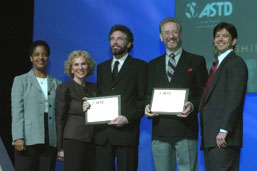 Steven Condly, Richard Clark and Harold Stolovitch recently received the
American Society for Training and Development's (ASTD) Research Award
for Advancing Workplace Learning and Performance for their study on the
effects of incentives on workplace performance. The research award recognizes
an outstanding piece of research published in a refereed journal and that
holds major implications for practitioners of workplace learning and performance.
The incentives study was a meta-analytic review of all adequately designed
field and laboratory research on the use of incentives to motivate performance.
Pictured above are Steven Condly (third from left) and Harold Stolovitch
(second from right) receiving the award from ASTD officials. Click here
to read the summary of the study.
Steven Condly, Richard Clark and Harold Stolovitch recently received the
American Society for Training and Development's (ASTD) Research Award
for Advancing Workplace Learning and Performance for their study on the
effects of incentives on workplace performance. The research award recognizes
an outstanding piece of research published in a refereed journal and that
holds major implications for practitioners of workplace learning and performance.
The incentives study was a meta-analytic review of all adequately designed
field and laboratory research on the use of incentives to motivate performance.
Pictured above are Steven Condly (third from left) and Harold Stolovitch
(second from right) receiving the award from ASTD officials. Click here
to read the summary of the study.

 The
excitement has been building for months and Erica Keeps and Harold Stolovitch,
along with their faithful readership of Telling
Ain't Training (TAT), waited patiently as the companion
book to TAT was in the final publishing stages. At last, Training
Ain't Performance was
launched at the ASTD International Conference on May 23, 2004 in Washington,
DC. With over 2,000 copies sold in pre-sales, the book's popularity at
the conference was no surprise. Training
Ain't Performance books
were flying off the shelf and Harold and Erica were swamped at the book
signing event (see photo at left).
The
excitement has been building for months and Erica Keeps and Harold Stolovitch,
along with their faithful readership of Telling
Ain't Training (TAT), waited patiently as the companion
book to TAT was in the final publishing stages. At last, Training
Ain't Performance was
launched at the ASTD International Conference on May 23, 2004 in Washington,
DC. With over 2,000 copies sold in pre-sales, the book's popularity at
the conference was no surprise. Training
Ain't Performance books
were flying off the shelf and Harold and Erica were swamped at the book
signing event (see photo at left).
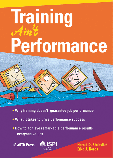 Training
Ain't Performance is
a whimsical, entertaining and solidly written book. From its first chapter,
"Show me the Money," to its concluding chapter, "Hit or
Myth: Separating Fact from Workplace Performance Fiction," readers
are gently guided toward an understanding of human performance improvement
and how to use it for real organizational value. You will not only be
introduced to key performance concepts including why training is often
not the only answer, but also how to realistically transition from a "training
order taker to a performance consultant." In addition to this practical
advice, Training Ain't Performance
contains a "cornucopia" of performance interventions
along with help on the day-to-day work of a performance consultant plus
demonstrating ROI for performance interventions.
Training
Ain't Performance is
a whimsical, entertaining and solidly written book. From its first chapter,
"Show me the Money," to its concluding chapter, "Hit or
Myth: Separating Fact from Workplace Performance Fiction," readers
are gently guided toward an understanding of human performance improvement
and how to use it for real organizational value. You will not only be
introduced to key performance concepts including why training is often
not the only answer, but also how to realistically transition from a "training
order taker to a performance consultant." In addition to this practical
advice, Training Ain't Performance
contains a "cornucopia" of performance interventions
along with help on the day-to-day work of a performance consultant plus
demonstrating ROI for performance interventions.
Petti Van Rekom, Regional Manager of Training and Development for The Coffee Bean and Tea Leaf, recently wrote a review on Training Ain't Performance for the American Society for Training and Development's monthly magazine, T+D. Click here to read the review.
To order a copy of Training Ain't Performance, click here.

Harold Stolovitch and Erica Keeps have launched the first two toolkits in the Pfeiffer Learning and Performance Toolkit Series. Leading organizations all over the world are already designing, managing and evaluating successful training, learning and performance projects using the tools previously only available in their workshops. Now these essential tools are at an arm's reach. These indispensable toolkits coach readers through the entire process.
Front-End Analysis and Return on Investment Toolkit
Click on the above book cover to read an excerpt and/or to purchase this publication.
Front-End Analysis and Return on Investment Toolkit is a comprehensive collection of guidelines, job aids, rich examples and tips that give readers the information needed to create performance interventions that will deliver the desired results. It also includes a robust "plug and play" CD-ROM that helps users actually derive a bottom-line ROI number. By using this vital resource you will be able to analyze training requests on the front end, measure worth and ROI in learning and performance on the back end, as well as much more.
Engineering Effective Learning Toolkit
Click on the above book cover to read an excerpt and/or to purchase this publication.
Engineering Effective Learning Toolkit is a hands-on resource that offers a systematic, 14-step approach for designing and evaluating successful training, learning and performance projects. The accompanying CD-ROM includes easily reproducible and customizable charts and job aids to help you accomplish each step in the instructional design process.
James D. Russell, Professor Emeritus of Educational Technology at Purdue University, recently wrote a review on Engineering Effective Learning Toolkit for the International Society for Performance Improvement's publication, Performance Improvement Journal. Click here to read the review.

 Yes,
you heard it here first! Erica is very outspoken about her non-cooking
persona. She simply doesn't cook! And,
then a wonderful opportunity came up to learn to cook (and get over her
fear of the kitchen) at Hilton Head Health Institute (HHHI). Harold and
Erica have been participating in HHHI's healthy lifestyle program for
over 20 years. At HHHI, Erica not only learned to cook, but to cook healthfully
under the direction of Executive Chef Cathryn Matthes (a.k.a. Chef C).
Yes,
you heard it here first! Erica is very outspoken about her non-cooking
persona. She simply doesn't cook! And,
then a wonderful opportunity came up to learn to cook (and get over her
fear of the kitchen) at Hilton Head Health Institute (HHHI). Harold and
Erica have been participating in HHHI's healthy lifestyle program for
over 20 years. At HHHI, Erica not only learned to cook, but to cook healthfully
under the direction of Executive Chef Cathryn Matthes (a.k.a. Chef C).
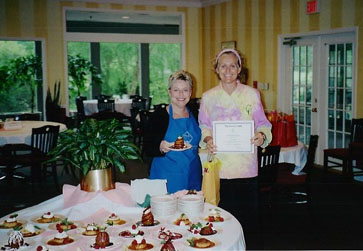
Partcipants of the Healthy Table Cooking School represented all levels of cooking experience. Erica's learning curve was the steepest to climb. She found the class very challenging but mastered most new skills…except for pan flipping vs. stirring and chopping with a chef's knife like the pros do. Harold was an official taster and he was simply amazed!
In the photo above, Erica is pictured with Chef C at graduation surrounded by delicious, low calorie desserts Erica and her classmates created. Can you believe a banana flan with caramel for only 175 calories? For more information about HHHI and the Healthy Table Cooking School, visit their Website at www.hhhealth.com.
So what's all this got to do with HSA, learning or performance? Plenty! At HSA, its principals and associates are encouraged to continue their education…in any area of choice. By getting back into the role of the learner, we all become more sensitive to the three critical C's of instruction excellence: competence, confidence and caring. In the learner's seat we observe what works and what doesn't. We become more committed to the Telling Ain't Training mantra: learner-centered, performance-based. We learn more than the content, we grow as learning specialists as well.
When was the last
time you took a course in anything? Give it a try! You'll benefit and
have fun in the process. Perhaps
one of HSA's seminars would fit the bill. Click here
to learn more about HSA in-house workshops.

From time to time, we come across interesting articles that we feel are important to share with others. Our Guest Author Series will feature these articles by various professional colleagues. The second in our series is by Kim Shepherd, one of our Call Center Consortium partners (www.callcenterconsortium.com) and president of Decision Toolbox (www.decisiontoolbox.com).
Smart Screening: Getting the Most Out of a 30-minute Prescreen
Kim Shepherd, Decision Toolbox
Almost all hiring managers acknowledge that prescreening is an important part of the hiring process, and most conduct a phone conversation with applicants before scheduling an in-person interview. In an informal survey of 20 hiring managers, Decision Toolbox found that over 90% conduct initial phone prescreens. The reasoning is simple: a resume and cover letter speak volumes, but even the briefest phone conversation, quite literally, can breathe life into paper's one-dimensional picture. However, prescreens can easily become a non-value adding bottleneck in the hiring process. Targeted, behavioral based prescreen questions, "make or break" logistical questions, and a strict time limit can ensure that you get the most out of a prescreen, and in the end, save yourself valuable time by avoiding interviews with unqualified applicants.
Let's start with purpose. Why do most hiring managers conduct prescreens? Decision Toolbox posed that question to some of its hiring managers and received some telling answers. Some common themes were:
- "To get an overall sense of the applicant's communication skills."
- "To learn the applicant's salary expectations."
- "To gauge the applicant's level of interest in my opening."
Some sample questions these managers pose in the prescreening process were:
- What prompted you to apply to our company?
- What are some of the things that you value in an employer?
- How would you describe your work style and your work ethic?
- How do you continue to stay current with trends in your field?
While these questions might elicit interesting conversation, they are not the best (and fastest) way to get the most value from the call.
These leading questions encourage "fluff" answers and don't significantly deepen the interviewer's understanding of the applicant's skills. A key fact to remember is that whoever passes your prescreen will then be cleared to take up at least an hour of your time in an in-person interview. In the words of one hiring manager: "You can't be quick to interview a warm body. You really have to make sure you've thought it through and found the best possible candidate to bring into the company for an hour or two of your time."
The purpose of the prescreen should be to draw clear parallels between the skills of the candidate and the requirements of the job, and to address any high-level reasons why the applicant might not be a good "fit" for the role. To accomplish this, the prescreen should be limited to behavioral questions related directly to the open position, and questions that uncover any barriers that might arise later in the hiring process, such as salary expectations, relocation, or offers pending from other companies.
Behavioral prescreening involves identifying the top "key success factors" specific to the job and your company's culture. For illustration, let's consider a Customer Service Representative opening at a manufacturing company. This company has a very aggressive growth oriented culture, and likes to promote high achieving CSRs to other parts of the company. However, they also need a contingent of "lifers" on their customer service team. The CSR acts as the first point of contact for the company's professional client base, has to answer questions about a very diverse product line, and is responsible for reinforcing the company's brand and image.
The key success factors for this particular CSR role are: 1) ability to learn and retain complex product and customer information; 2) willingness to research and resolve customer questions; 3) flexibility and an openness to a growth-oriented, changing environment; and 4) motivation to be a truly exceptional member of the CSR team - or - for career advancement. The prescreener's challenge is to uncover the applicant's ability to meet these success factors in 20 minutes or less. The remaining 10 or 15 minutes of the prescreen is spent on motivation and logistics. Here is a complete sample prescreen for this job opening:
Job-Specific
Qualifiers: Time guideline: 20 minutes
- Give me an example of the type of customers you interact with in your current or most recent role, the nature of the products/services you represent as a CSR, and the degree of complexity in your role.
- Give me an example of how you met the needs of a difficult or demanding customer and actually solved their request/problem.
- How have the requirements of your role changed? Have you had to learn new skills as a result of this change? Do you prefer more stability or change in your role?
- Do you see customer service as your ideal career? Why? As a launching pad to other positions within our company? Why?
Motivation/Priorities: Time guideline: 5 minutes
- Why looking/what for? (desired advantages over current/most recent position)
- If employed, what would make it difficult to leave?
- Actively looking/other interviews?
- Appeal of this position? Why a good fit?
- Background check? Drug, physical, degree...
Logistics: Time guideline: 5 minutes
- Salary.
- Commute.
- Relocation.
- Education.
- Resume continuity.
- Availability to start.
- Availability to interview.
- Obstacles.
While the Job-Specific Qualifiers help you to screen in candidates who are more likely to be a success, the Motivation and Logistics questions help you to identify any obstacles that may arise during the hiring process. The problem is, many companies leave these important questions until the offer stage and background check. By waiting to ask simple questions such as "Can your degree be verified?", "Are you willing to take a salary within our range?" and "Do you have any other offers or interviews pending?" candidates can make it through almost the entire hiring process before being eliminated. If you've invested all of your time interviewing and pursing a candidate who eventually falls out because the salary is too low, or the commute is too far, many times you are back to square one and behind schedule on your hire.
By conducting high quality prescreens, you will save time, and in the end, money. Prescreening impacts the bottom line by: 1) speeding up the hiring process; 2) generating higher quality hires and reducing turnover; and 3) reducing wasted time in the interview process.
As a final note, prescreening is a step in the hiring process where a neutral third party can offer valuable perspective. Many hiring managers, overwhelmed with qualified applicants, tend to screen in applicants who share similarities with their own background and experience. According to one hiring manager: "I didn't know whether I was doing it consciously or subconsciously, but I was trying to hire people who were like me, who I felt had the same strengths and weaknesses I had." Personal bias can limit the diversity of your team and screen out otherwise excellent candidates. By having an outside source choose their job candidates, employers can be more confident that their final applicants are the result of impartial opinion, rather than personal bias. A preliminary search on the Internet can connect you with a list of companies offering impartial, educated help.

 Harold Stolovitch will be the keynote speaker at ISPI's Performance-Based
Instructional Systems Design (ISD) conference this September in Chicago.
While there, he will also be conduct HSA's FEA & ROI Workshop.
Harold Stolovitch will be the keynote speaker at ISPI's Performance-Based
Instructional Systems Design (ISD) conference this September in Chicago.
While there, he will also be conduct HSA's FEA & ROI Workshop.
Harold will also be Master of Ceremonies and presenting at the ASTD's Telling Ain't Training mini-conference this October in Chicago. Limited seats are still available. The first time this was held in Alexandria, VA in June it was totally sold out! For more information, click here.
Click here to view HSA's Events Calendar to learn where and when Harold will be speaking as well as to read session descriptions.

 Do
you have any burning human performance technology questions? Visit the
Ask Harold section of HSA's Website
and ask your questions for Harold Stolovitch to answer. Here is a recent
submission that might intrigue you:
Do
you have any burning human performance technology questions? Visit the
Ask Harold section of HSA's Website
and ask your questions for Harold Stolovitch to answer. Here is a recent
submission that might intrigue you:
What are some standard questions that should always be asked when speaking with a SME to ensure you find out everything you need to know?
To read the response, visit Ask Harold. To ask your own question, just click on the crystal ball above, fill out the form and click submit.
For more information on HSA, visit our Website at
www.hsa-lps.com, email us at info@hsa-lps.com or
call us toll free at (888) 834-9928.
If you have any questions or comments, please feel free to contact Samantha Greenhill, Publications and Communications Specialist, at sgreenhill@hsa-lps.com.

To unsubscribe from this Newswire, please reply to this email and put the word UNSUBSCRIBE in the subject line.
© Copyright 2004 Harold D. Stolovitch & Erica J. Keeps