
By Harold D. Stolovitch & Erica J. Keeps
hstolovitch@hsa-lps.com & ekeeps@hsa-lps.com
 We've
often heard the expression, "different strokes for different folks."
In a broad sense, the four major types of training we describe here are
for different types of learners. Let us caution you right away. The same
learner may be an excellent candidate for all the types of training -
but at different stages of her or his learning with respect to a specific
skill or knowledge area. We'll examine each of the types and determine
how you can use them appropriately.
We've
often heard the expression, "different strokes for different folks."
In a broad sense, the four major types of training we describe here are
for different types of learners. Let us caution you right away. The same
learner may be an excellent candidate for all the types of training -
but at different stages of her or his learning with respect to a specific
skill or knowledge area. We'll examine each of the types and determine
how you can use them appropriately.
The four types of training are receptive, directive, guided discovery and exploratory. Various learning researchers and professionals use other classification systems and names. We find these four, which Ruth Clark (1998) employs, to be convenient and useful.
Receptive Training
This type of training falls into the "telling" mode. Essentially, the view of the learner is that of a vessel into which good, wholesome, nutritional information is poured. The danger in using this type of training is that there is an expectation that learners will be able to convert what they hear and see into usable skills and knowledge.
There is, however, some limited value to the receptive mode. Basically, it makes learners "aware." Well done and presented in an interesting manner, it can demonstrate value to the learners and build their motivation to accept, learn, support and desire to discover more. For highly knowledgeable learners, it may be sufficient for them to make connections with and adapt prior knowledge to new circumstances. The training content is frequently transmitted in one direction. Learners have little or no control, except to tune out, turn off or daydream.
Sadly, much of what is called training in the workplace is of a receptive nature. Here is a true case we experienced in a very progressive, world-renowned high-tech company:
A team of highly qualified software engineers (PhDs) had just completed a major overhaul of an operating system (O/S). They were tasked with going out to train the worldwide group of engineers who would support and troubleshoot the new, improved O/S. Their approach to the training was to provide each participant with a manual (approximately 1,200 pages) and tell them about the new and upgraded O/S, how it was developed, how it differed from its forerunner, what their challenges had been, how they have overcome them, what they had had to leave out, and so forth. When we asked if they were going to have participants engage in troubleshooting practice, they were taken aback. They hadn't planned on it.
Given their target audience of system troubleshooters, is that how you would have gone about the training? The receptive type of training can have a limited role in introducing something new, presenting fascinating anecdotes, and building awareness and enthusiasm, but it soon wears thin with any audience. Our bottom-line advice with respect to receptive-type learning is to use it sparingly. Always seek an alternative, except in the case of short, consciousness-raising sessions.
Directive Training
This approach to training is akin to the U.S. Army infantry slogan: "Follow me." As its name suggests, this method directs. In this approach, you analyze the knowledge and skills required to lead learners from where they are to where you want them to be. You create clear performance objectives and matching test items. Then you organize and sequence learning blocks or units that direct the learners from their starting positions to defined intermediate and final finishing lines. There's little learner control, but, unlike in the receptive type of training, learners are actively and meaningfully engaged as they progress along predetermined paths.
The directive approach is particularly well suited for learners who have little experience with the learning content, require support to build competence and confidence, and will later perform on the job in ways that are identical or very similar to what they learn in the training.
Guided Discovery
In this type of training, control is shared between the learner and the trainer or training program. Guided discovery is generally case-based. Learners immediately plunge into cases, scenarios, or problems. They may require some initial input, but mostly they take the initiative. The learners may reach out to a variety of information sources or support tools, either physically material or electronic, to deal with the situation. The learners themselves have to discover what to do and when to do it. They seek and identify appropriate information and tools to proceed. The instructor or instructional program offers assistance in the forms of cues, prompts, suggestions, and corrective feedback along the way or redirection, consulting services, and debriefings. The amount of guidance or support as well as its nature depend on the skill and knowledge level of the learners. For less knowledgeable, less independent, or less confident learners, the training may include a great deal of guidance. The more capable and knowledgeable (or skilled) the learner is, the more independently he or she can function. In that case, the role of the trainer or training is to confirm, debrief, add editorial nuances, proffer variations, and, of course, reward. When learners achieve high degrees of competence and confidence, they are ready for the next type of training.
Exploratory Learning
Here we build and organize a rich learning and informational environment for the learners and then truly get out of the way. The learners are in control. They know what is required and set out to search for whatever exists to resolve the issue and help them progress to the next level. Usually, there are only general goals set (often by the learners). Large databases of information integrated into a knowledge management system provide an ideal environment for exploratory learning. At a less sophisticated level, a workshop with all the tools, materials, and manuals does the same thing. Learning is usually individualized. The trainer can monitor and provide feedback or support and debrief as required. In exploratory learning, the trainer is essentially a resource for the learners.
Pulling the Four Types of Training Together
There is a natural progression among the four types of training with respect to learner control and sophistication. To conclude the discussion of these types of training, here are some summary points:
- All of the types are different ways of approaching training.
- All of the types have a place in training, but the receptive approach is the most frequently used method - and it should be the least often employed. Essentially, it's just telling, and telling ain't training.
- Directive learning provides the trainer and the organization with the greatest control. The side effect is decreased learner initiative and more narrow, nearer transfer-of-learning potential.
- Guided discovery is an excellent, balanced training approach for encouraging learner initiative under safe conditions. Learning results are usually stronger and more fluid (for example, transfer to a broader range of situations). Learning results are less predictable, and learning time may increase.
- Exploratory learning is powerful for sophisticated, capable learners. It allows for greater individualization and personalization of learning. However, it requires sufficient resources, decreases trainer control, and is unpredictable in terms of specific outcomes.
Our recommendation is to use the receptive type very seldom. Focus on the other three. Mix and match your approaches to fit the needs of both the learners and learning. Above all, keep the training active.
This
article is an excerpt from Harold Stolovitch and Erica Keeps' award-winning,
best-selling book, Telling Ain't Training. For
a more detailed discussion of
training types, click here
to order a copy of the book.

By Erica J. Keeps & Harold D. Stolovitch
ekeeps@hsa-lps.com & hstolovitch@hsa-lps.com
 Consulting
is a process of building a relationship, identifying needs, sharing expertise,
recommending appropriate, economical, feasible, acceptable interventions
and helping translate all of this to successful results for your client
and the organization. An excellent consulting engagement is based on creating
credibility and trust, which enhances your ability to influence those
who are the decision-makers and hold the levers of power.
Consulting
is a process of building a relationship, identifying needs, sharing expertise,
recommending appropriate, economical, feasible, acceptable interventions
and helping translate all of this to successful results for your client
and the organization. An excellent consulting engagement is based on creating
credibility and trust, which enhances your ability to influence those
who are the decision-makers and hold the levers of power.
How you achieve consulting success is through the following:
- Listen actively and completely. Immerse yourself in your client's issues and concerns. Listen beyond the words to the deeper meanings. Do your homework beforehand, learn about your client, the organization she or he represents and key issues. Hear what is being said. Record (in writing) what your client tells you. This shows respect for the client's words and helps you focus on and retain important points.
- Ask a lot of open-ended questions. The client may come to you with a request. Offer reassurance that you can "solve the problem," and then drive toward the business need and the human performance requirements. Examine the brief case below.
|
Case: Better Communication Call Center Director (CCD): …and so we've got to get the supervisor and team leads better trained on how to communicate with their customer service agents. Performance Consultant (PC): I can help you solve this problem. I'd really like to understand the issue thoroughly so that I can best be of service. Can you tell me more? CCD: Our customer service agent turnover is way too high. And our exit interviews inform us that the problem often lies with the supervisor. PC: In what way? CCD: The complaint is that supervisors and team leads don't provide enough support, especially early on when we get our biggest washout and turnover. When there's a problem, they don't seem to listen or are in a hurry. They answer that the standards are there for all to follow. They show no flexibility when an agent has a personal problem. PC: If everything were working perfectly, what would be different? What would the most important change be? CCD: Well the most important change would be dramatically reduced agent turnover. That would save us millions of dollars and improve customer service. That's why I'm asking you for the communication course for supervisors and team leads. |
Examine all the questions the Performance Consultant asked. What do you notice? Check off the statements that match your perceptions.
- All the questions are open-ended. They lead to elaboration of the need.
- The questions focus on how best to deliver the communication course.
- The questions try to probe beyond the client request to determine the business need.
- The questions try to identify supervisor and team lead weaknesses.
If you carefully studied the questions the Performance Consultant asked, you probably noticed that they were all open-ended questions. Their purpose was to find out more about the real business need and uncover areas of weakness (1, 3 and 4). Asking such questions requires conscious effort. The result is that soon you have the client moving away from the original request and talking to you about the real issues. At this point, you are no longer the order taker, but a consultant.
- Filter; direct; probe. An essential part of consulting is getting beyond the surface. Most often, clients view us in a certain role and then pitch their words in light of their perceptions. If we are "trainers," they talk about training to us. If they see us as performance problem solvers and partners, their discourse changes. The successful consultant filters out the surface words, directs the client toward root issues and tirelessly (but diplomatically) probes until the ultimate concerns are articulated. A benefit of this consultative approach, similar to what often happens in therapy, is that the client comes up with what is really needed, thus becoming more open to a basket of performance interventions. They come to realize that the training alone won't lead to performance.
- Confirm that you have understood and are on the right track. Periodically verify with your client that you understand the need. Along the way, keep the client informed of what you are discovering. Check and recheck - showing data whenever possible - to ensure that both the client and you are on the same wavelength.
- Report. You are in a partnership with your client. Keep him or her current with respect to what you are accomplishing. The best consulting relationships are ones that maintain open channels of communication. Let all stakeholders know what is going on without inundating them with details. Keep reports crisp and to the point.
- Make the roadmap clear. No surprises please. Keep your clients and stakeholders aware of future actions and timelines. If everyone knows where she or he is going, the probability is high that you will all get there.
This article is based on Harold Stolovitch and Erica Keeps' newly released book, Training Ain't Performance. If you are interested in learning more about building your consulting expertise, click here to order Training Ain't Performance.


The American Society for Training & Development (ASTD) along with Harold Stolovitch has developed a Telling Ain't Training Mini Conference based on the best-selling, award-winning book of the same name. The conference was launched this past June in Alexandria, VA and due to popular demand, two more conferences were conducted this fall in Chicago, IL.
The Telling Ain't Training Conference offers an experiential approach to transforming “telling” into activities that result in long-term retention and behavior change. The Mini Conference shows you interactive, practical techniques that can be implemented immediately to improve your training programs. You'll come away with solid answers, backed by research and real-world experience, presented by the pros.
Missed attending a Telling Ain't Training Mini Conference in 2004? Don't despair! In 2005, two more will be held, one in Washington, DC and the other in Atlanta, GA.
For more information, visit ASTD's Website at http://www.astd.org/astd/conferences/TAT/tellingainttraining.

The American Society for Training & Development (ASTD) is now offering a discount when both Telling Ain't Training and Training Ain't Performance are purchased as a set.
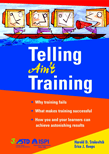 The
best-selling, award-winning Telling
Ain't Training tackles the three universal and persistent
questions of the profession of performance improvement - how do learners
learn, why do learners learn and how do you make sure that learning sticks.
It uses an interactive approach which models the basic message of the
book - humans learn best through active mental engagement. The ultimate
goal of the book is to allow the reader an opportunity to break through
learning barriers, to separate learning myth from research-based facts
and to dispel counter productive beliefs and practices that harm the instruction
process.
The
best-selling, award-winning Telling
Ain't Training tackles the three universal and persistent
questions of the profession of performance improvement - how do learners
learn, why do learners learn and how do you make sure that learning sticks.
It uses an interactive approach which models the basic message of the
book - humans learn best through active mental engagement. The ultimate
goal of the book is to allow the reader an opportunity to break through
learning barriers, to separate learning myth from research-based facts
and to dispel counter productive beliefs and practices that harm the instruction
process.
 Training
Ain't Performance, the companion
book to Telling Ain't Training,
is a whimsical, entertaining and solidly written book. From its
first chapter, "Show me the Money," to its concluding chapter,
"Hit or Myth: Separating Fact from Workplace Performance Fiction,"
readers are gently guided toward an understanding of human performance
improvement and how to use it for real organizational value. You will
not only be introduced to key performance concepts including why training
is often not the only answer, but also how to realistically transition
from a "training order taker to a performance consultant." In
addition to this practical advice, Training
Ain't Performance contains
a "cornucopia" of performance interventions along with help
on the day-to-day work of a performance consultant plus demonstrating
ROI for performance interventions.
Training
Ain't Performance, the companion
book to Telling Ain't Training,
is a whimsical, entertaining and solidly written book. From its
first chapter, "Show me the Money," to its concluding chapter,
"Hit or Myth: Separating Fact from Workplace Performance Fiction,"
readers are gently guided toward an understanding of human performance
improvement and how to use it for real organizational value. You will
not only be introduced to key performance concepts including why training
is often not the only answer, but also how to realistically transition
from a "training order taker to a performance consultant." In
addition to this practical advice, Training
Ain't Performance contains
a "cornucopia" of performance interventions along with help
on the day-to-day work of a performance consultant plus demonstrating
ROI for performance interventions.
For more informaiton or to order ASTD's Ain't Set, click here.

Harold Stolovitch and Erica Keeps have launched the first two toolkits in the Pfeiffer Learning and Performance Toolkit Series. Leading organizations all over the world are already designing, managing and evaluating successful training, learning and performance projects using the tools previously only available in their workshops. Now these essential tools are at an arm's reach. These indispensable toolkits coach readers through the entire process.
Front-End Analysis and Return on Investment Toolkit
Click on the above book cover to read an excerpt and/or to purchase this publication.
Front-End Analysis and Return on Investment Toolkit is a comprehensive collection of guidelines, job aids, rich examples and tips that give readers the information needed to create performance interventions that will deliver the desired results. It also includes a robust "plug and play" CD-ROM that helps users actually derive a bottom-line ROI number. By using this vital resource you will be able to analyze training requests on the front end, measure worth and ROI in learning and performance on the back end, as well as much more.
Engineering Effective Learning Toolkit
Click on the above book cover to read an excerpt and/or to purchase this publication.
Engineering Effective Learning Toolkit is a hands-on resource that offers a systematic, 14-step approach for designing and evaluating successful training, learning and performance projects. The accompanying CD-ROM includes easily reproducible and customizable charts and job aids to help you accomplish each step in the instructional design process.
James D. Russell, Professor Emeritus of Educational Technology at Purdue University, recently wrote a review on Engineering Effective Learning Toolkit for the International Society for Performance Improvement's publication, Performance Improvement Journal. Click here to read the review.

From time to time, we come across interesting articles that we feel are important to share with others. Our Guest Author Series will feature these articles by various professional colleagues. The third in our series is by Dr. Roger Chevalier, CPT, Director of Information and Certification for the International Society for Performance Improvement (www.ispi.org). He is a former vice president for Century 21 Real Estate Corporation’s Performance Division and a former training director for the U.S. Coast Guard’s west coast training center. Roger may be reached by email at rogerc@ispi.org or by telephone at (707) 584-7160.
The Books that Shaped Performance Technology: Still Worth Reading
By Roger Chevalier
This article was first printed in ISPI's June 2004 edition of PerformancExpress (http://www.performancexpress.org/).
Many organizations are doomed to implement the latest performance improvement fad as an ongoing strategy of “management by best seller.” It was George Santayana (1863-1952) who said, “Those who cannot remember the past are condemned to repeat it.” We owe a tremendous debt to those who came before us. We should all take the time to periodically return to the original works that form the basis for what we do now in our field of performance technology.
While there were earlier books that laid the foundations for our profession, three books stand out as providing the structure for the way in which we do business today: Joe Harless’s An Ounce of Analysis (Is Worth a Pound of Objectives) in 1970, Tom Gilbert’s Human Competence in 1978, and Bob Mager and Peter Pipe’s Analyzing Performance Problems in 1984. I remain amazed at the number of authors who borrow extensively from these authors (without giving them the credit they deserve) for their “latest and greatest ideas” on performance improvement.
More recently, three additional books changed the way in which we view organizations and shaped the role of the performance consultant in the 1990s: Geary Rummler and Alan Brache’s first and second edition of Improving Performance: How to Manage the White Space on the Organization Chart in 1991 and 1995, Dana and Jim Robinson’s Performance Consulting: Moving Beyond Training in 1996, and Judy Hale’s The Performance Consultant’s Fieldbook: Tools and Techniques for Improving Organizations and People in 1998.
But perhaps the greatest impact on formalizing the body of knowledge for our profession was the publication of the first and second editions of the Handbook of Human Performance Technology in 1992 and 1999, masterfully edited by Harold Stolovitch and Erica Keeps. These two books are still the best references that we have on our bookshelves, instantly making available the work of many experts in the field of HPT.
More recently, Darlene Van Tiem, Jim Moseley, and Joan Dessinger published the first and second editions of Fundamentals of Performance Technology in 2000 and 2004, which provide a model of the performance technology process (derived from earlier work by Bill Deterline and Marc Rosenberg), with text that someone new to our field or a line manager can read and understand.
And now, three new books have appeared that will further shape the way in which we understand and apply performance technology. Serious Performance Consulting According to Rummler by Geary Rummler, and Training Ain’t Performance by Harold Stolovitch and Erica Keeps, are by three of our most respected practitioners and authors. The third book, Human Performance Technology Revisited, collects more than 50 Performance Improvement articles from many of the best authors in our field.
While it is important that we keep up with the latest books in our field, it is just as important that we return to the original works that have shaped our profession. Reading the books that are the foundation of our profession is similar to enjoying classic movies, such as The Lion in Winter or Twelve Angry Men, to see the cinematic roots of the current movies that we enjoy today.
Do you have an article that you would like us to consider including in our Guest Author Series? If so, please contact Erica Keeps at ekeeps@hsa-lps.com.

 Harold
will be presenting at the International Society for Performance Improvement's
(ISPI) Michigan Chapter on October 28 and 29 in Detroit, MI, the Canadian
Society for Training & Development (CSTD) Conference in Toronto, ON
on November 2 and 3, and the American Society for Training & Development's
(ASTD) Sun Coast Chapter in Tampa, FL on November 18 and 19.
Click here
to view HSA's Events Calendar to learn where and when Harold will be speaking
as well as to read session descriptions.
Harold
will be presenting at the International Society for Performance Improvement's
(ISPI) Michigan Chapter on October 28 and 29 in Detroit, MI, the Canadian
Society for Training & Development (CSTD) Conference in Toronto, ON
on November 2 and 3, and the American Society for Training & Development's
(ASTD) Sun Coast Chapter in Tampa, FL on November 18 and 19.
Click here
to view HSA's Events Calendar to learn where and when Harold will be speaking
as well as to read session descriptions.

 Do
you have any burning human performance technology questions? Visit the
Ask Harold section of HSA's Website
and ask your questions for Harold Stolovitch to answer. Here is a recent
submission that might intrigue you:
Do
you have any burning human performance technology questions? Visit the
Ask Harold section of HSA's Website
and ask your questions for Harold Stolovitch to answer. Here is a recent
submission that might intrigue you:
I
read
your article "Keys to Performance Consulting Success." However,
it still seems like there's a huge canyon to bridge between doing training-only
and performance improvement. You have to acquire the skill set (hire new
people) to get the clients for performance improvement. How do you justify
acquiring the skill set if you don't have the clients?
To read the response, visit Ask Harold. To ask your own question, just click on the crystal ball above, fill out the form and click submit.
For more information on HSA, visit our Website at
www.hsa-lps.com, email us at info@hsa-lps.com or
call us toll free at (888) 834-9928.
If you have any questions or comments, please feel free to contact Samantha Greenhill, Publications and Communications Specialist, at sgreenhill@hsa-lps.com.

To unsubscribe from this Newswire, please reply to this email and put the word UNSUBSCRIBE in the subject line.
© Copyright 2004 Harold D. Stolovitch & Erica J. Keeps