
By Harold D. Stolovitch & Erica J. Keeps
hstolovitch@hsa-lps.com & ekeeps@hsa-lps.com
 It
is common practice to spice up instruction with the use of games and game-like
activities. However, how can they best be used and why do they work? This
article addresses these two questions.
It
is common practice to spice up instruction with the use of games and game-like
activities. However, how can they best be used and why do they work? This
article addresses these two questions.
Games and similar activities are excellent learning vehicles for:
- introducing new skills, concepts or content. Imagine that your learners have never experienced outdoor winter activities in the snowy mountains. They are about to go off on a trip to such a region for work, but will have some time to enjoy outside recreational opportunities. A simple board game you have titled "Mountain High" has players follow trails where they land on "incident" and "question" squares, and either have to cope with the incident (or suffer realistic consequences) or answer questions about safety and survival. This game can open them up to the real dangers of what appears on the surface to be a winter wonderland. Similarly a Bingo-like game that uses products instead of numbers can be employed to open a learning session for new hires at a home improvement megastore.
- integrating new learning by providing practice and feedback. Your learners are taking a boating navigation course and have learned about various cloud formations, their names and appearance characteristics. Why not help solidify the learning with a Concentration-type game that has learners pairing pictures of clouds with their names? You could add humor to the title of the game by calling it "Bring in the Clouds."
- testing assumptions. How can we get an innovation to be adopted in an organization? Why not try to do this in teams? Using an activity called "Innov-Eight," various learner teams are provided with scenarios in which they have to figure out how to get an innovation (for example, transforming an instructor-centered, content-based way of training to a learner-centered, performance-based approach) adopted in eight weeks (derived from an adoption of innovation model). At each step, they make decisions and initiate actions based on information embedded in the game feedback.
- trying out strategies. In the 19th century the Prussian army played strategy games to determine the best way to invade and conquer Austria. Based on the strategies they tried out in their gaming sessions, the Prussians invaded Austria and within seven weeks had conquered the country - a once-invincible power. Military, political, business and economics strategists still use games and game-like activities to test their tactics.
- generating insights. Games and game-like activities can trigger "Aha!" moments in learners. Sociologist Cathy Greenblatt created a group-based simulation-role play game called "Blood Money," which models how hemophiliacs have to deal with the medical system, family and work. By playing the game, real family members, coworkers and medical professionals see the world from the hemophiliac's perspective and achieve a number of valuable insights. A cross-cultural game-like activity, "Bafá-Bafá," created by Gary Shirts and used in military and corporate settings, opens players' eyes to how quickly they build up prejudices and readily make negative judgments about other cultures.
- evaluating learning and performance. You learned something; you can pass a written test. But can you apply what you learned? Why not see how well you perform in this game called "Confrontation?" You are a university-based pastor, often called upon to mediate disputes. You have learned the principles of mediation, so "Confrontation" places before you a range of scenarios. The pastors form groups of three. Two of the pastor-players assume opposing roles in situations they might encounter in their work (for example, a female student who wants to marry and her mother who feels she is far too young). The third player is the mediator. They have a time limit to achieve consensus. Players rotate roles after each scenario. Everyone has tokens that are won or lost, depending on the degree of consensus in each scenario. The pressure is on to perform!
- building teams. Sivasailam Thiagarajan has created a wonderful game-like activity titled "Kindred Spirits." Virtually any number of learners can participate. A general topic such as "workplace equity" is given. Through a series of different rounds in which the activities change, naturally selected teams emerge that have like-minded ideas. They create a team logo, a philosophy, a T-shirt slogan and an action plan. A variation of this activity, "Our School," has successfully engaged middle-schoolers in developing teams that come up with actions to improve the spirit of their school in very different, but relevant ways.
- improving communication. Here's a game that focuses on building better communication on issues about which there are extreme views. It is called "The Great Debate." An issue that generates polarized positions is selected (for example, abortion, merit pay, plans for a megastore in the community or government-supported universal health care). Participants take an opinion quiz (usually a Likert five- or seven-point scale type of test) that is easily scored and that establishes their views on the issue. Based on scores, the participants are divided into "for" and "against" teams. Those with neutral scores become the judges. To foster better communication, the "for" players are given a variety of subtopics on the issue. They break into smaller teams, each with one subtopic, and prepare to debate against the issue on their subtopic themes. Similarly, the "against" players must prepare to debate for the issue. Assuming positions opposite of those they normally hold forces participants to consider the other point of view. Debate ensues (each team has two minutes). The judges decide the winning team based solely on debating points. A general debriefing follows.
- revealing to participants how easy it is to mangle communication when it travels a distance from the source. Try the children's game called "Broken Telephone" or "The Whisper Game." A phrase is repeatedly whispered from one player to the next, until the last person repeats the phrase aloud (and likely discovers it's nothing like the original phrase).
- creating action plans. Several of the games and game-like activities mentioned above readily lend themselves to action planning. The "Mountain High" game can feed right into the creation of safety action plans. The same is true for "Innov-Eight," war and business games, and variations of "Kindred Spirits." There are, however, specific games and game-like structures that are designed to achieve action planning. One of these, "NAG (Needs Analysis Game)" by Thiagarajan takes any number of participants and, after separating them into teams, generates a prioritized list of needs with respect to an issue (for example, increase promotions for women and minorities, provide better service to elderly riders on our buses, penetrate new markets or solution sell [as opposed to product sell]). The outcome of this highly involving activity is not only a priority list of needs, but also concrete actions participants will initiate and support. The power of this game-like design is that those charged with carrying out the actions are the ones who generated them. Buy-in is high.
And so much more…. These engaging games and game-like "designs" are all learner-centered and performance-based. Outcomes are verifiable and generated by the participant-learners themselves. Other potential uses of these designs include operational planning, problem solving, learning a foreign language and discovering how a system works.
Why do Games and Game-like Activities Work?
The four main reasons are these:
- They create artificial systems with arbitrary sets of rules. When the learners accept to participate, they also agree to accept the new rules of conduct, and are free to let go of their usual ways of acting and thinking. This is both a liberating and a revealing experience. Learners in this state are more open (also vulnerable) to other ways of doing things. After all, it's only a game. It's also fun to be allowed - even forced - to be different. The participants are just following the rules.
- When learners enter an activity or game, they are starting off fresh. Anything that has happened to them before in "real life" has no meaning here. This is a new opportunity for success.
- Games, in particular, model what research has shown to foster learning success: why, what, structure, responses, feedback and reward. All are embedded in games. It's not a coincidence that games facilitate learning.
- Games and game-like activities incorporate three characteristics research has shown to stimulate learning: challenge (triggers an adrenalin rush, increasing alertness and attention); fantasy (stimulates the imagination; it is not the real world, but an intriguing one); and curiosity (promotes attention; what will happen next?).
Incidentally, if your
learners are uncomfortable with the term game, substitute interactive
activity or participative exercise instead. Whichever word or euphemism
you use, the games and game-like activities mentioned in the article all
work equally well.
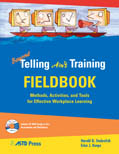
This article is an excerpt from Harold Stolovitch and Erica Keeps' bestseller,
Beyond Telling Ain't Training Fieldbook.
Interested in learning more? Click here
to order a copy of the book.

Harold Stolovitch recently discussed "Training Ain't Performance" with ISPI Michigan's Jennifer Eichenberg. The first of the podcasts can be accessed at http://www.ispimi.org/podcasts/052109/Podcast_1.htm and the second at http://www.ispimi.org/podcasts/052109/Podcast_2.htm.
Harold will be the featured speaker at ISPI Michigan's Annual Signature Program on November 19, 2009 as well as conduct his Training Ain't Performance workshop on November 20, 2009. For more information and/or to register for either event, visit ISPI Michigan's website at http://ispimi.org/.

 Talent
Management is a monthly magazine directed to top-level management,
senior human resources and workforce and organizational development executives
whose task is to optimize the abilities of their human assets to drive
and improve the execution of enterprise strategy.
Talent
Management is a monthly magazine directed to top-level management,
senior human resources and workforce and organizational development executives
whose task is to optimize the abilities of their human assets to drive
and improve the execution of enterprise strategy.
Harold Stolovitch is the regular "Human Performance" columnist for Talent Management magazine. You can read his latest article, "The Woes of Performance Consulting " by visiting page 12 of the September 2009 digtial edition at http://www.nxtbook.com/nxtbooks/mediatec/tm0909/#/14. For more information on Talent Management, visit their Website at www.talentmgt.com. If there are any topics that you would like Harold to address in his column, please email him at hstolovitch@hsa-lps.com.

 Have
you made your plans to join ASTD for the Telling Ain't Training Conference?
Based on the best selling book of the same name, this conference explores
the art of engaging employees in training programs using interactive activities
to stimulate conversation and interest.
Have
you made your plans to join ASTD for the Telling Ain't Training Conference?
Based on the best selling book of the same name, this conference explores
the art of engaging employees in training programs using interactive activities
to stimulate conversation and interest.
There are only two more chances to attend this popular event this year: October 14-15 in Atlanta, GA or on October 23 in Toronto, Canada where Harold Stolovitch in partnership with The Canadian Society for Training & Development will run a one-day program. Register today to gain valuable tools to improve your training programs and promote long-term retention and behavioral change in your organization. For more information, visit tat.astd.org.

 Dr.
Harold Stolovitch, Emeritus professor, Human Performance at Work and Principal
of HSA Learning & Performance Solutions, has successfully developed
workplace learning and performance professionals for over 40 years. He
is an experienced keynote speaker, workshop leader, author and consultant
who has worked with hundreds of major corporations and professional organizations
throughout the world.
Dr.
Harold Stolovitch, Emeritus professor, Human Performance at Work and Principal
of HSA Learning & Performance Solutions, has successfully developed
workplace learning and performance professionals for over 40 years. He
is an experienced keynote speaker, workshop leader, author and consultant
who has worked with hundreds of major corporations and professional organizations
throughout the world.
Harold is available for presentations, keynote addresses, consulting and workshops at corporations and professional organizations. Click here for more information.

Our Guest Author Series
features articles by various professional colleagues. The latest in our
series is by Erica Groschler. Erica is President of TPS Consulting (www.tpsconsultingltd.com)
and specializes in organizational development. She can be reached at ericag@telus.net.
Engagement: The Key to Helping People through Transition and Change
By Erica Groschler
How often do we hear stories about change implementations that have gone awry? What contributes to the challenges of effectively implementing a change? What is missing?
With people becoming increasingly cynical about so many organizational transformations, it doesn't help that the traditional "change management" approach (i.e., sponsor or steering committee-led) only reinforces the jaded impression of just another top-down initiative, which in turn, triggers resistance.
So how can we better support changes?
Consider the sandbox as a metaphor for your latest organizational change. How big is this sandbox? Has management created a sandbox so small that there is little, if any, room to maneuver? Or has it offered a large, open sandbox with a lot of opportunity for stakeholders to participate and create?
Continuing this image, it would be far more satisfying if all the players could become actively engaged. Unfortunately, very few organizational changes provide well thought out 'play areas' where affected individuals can contribute, define and influence the terrain in which they will ultimately be very much involved.
Engagement Principles
With a narrowly constrained change sandbox, there is often minimal opportunity to influence or contribute to a proposed future state. This can cause problems to arise in its implementation. What follows is a set of principles that will help improve both acceptance and facilitation of change, regardless of its size and scope.
1. Involve those affected by the change
Traditional change management generally occurs in top-down fashion. The implicit message this sends is that management believes productivity will suffer if too many people get involved in the transformation. This stands in contradiction to what actually happens when there is high involvement in the change process of affected parties as early as possible. Experience demonstrates a much higher likelihood of increasing stakeholder ownership in the change with early involvement, and a concomitant decrease in resistance.
As an example, a 1,200-person company was planning a move to a new facility/location in three years. The engagement strategy incorporated an initial large group conferencing* methodology which included customers, front-line staff, community partners and all levels of leadership to define the future state and culture of the new organization. A year later, the same groups were brought together again to help design, in more detail, the future state of the organization, focusing particularly on the interdependencies of departments. Finally, in the year before the relocation, all the players were once more reassembled to participate in a conference to learn about change and transition as well as to help create strategies for mutual support through what was anticipated to be a significant, transformational process.
2. Honor the past and present
William Bridges**, an internationally recognized specialist on managing change, states that "it isn't the changes that do you in, it's the transitions." Transition starts with an ending - a letting go of the old reality. Frequently, when change is introduced, people begin to fear that they will lose something they valued in the old way of doing things. Allowing time to support people through this part of the transition by helping them honor the past can reap huge benefits both for them - decreased anxiety and peace of mind - and, ultimately, the organization as they contribute to facilitating the transition and creating their future roles within the new environment. (This can be done through scenario building, storytelling, creating maps that link to the past and generating learning histories.)
3. Surface people's resistance
Driving change through like a bulldozer will not eliminate people's resistance. In fact, it is more likely to increase it. Far better, therefore, to design interventions that surface the resistances and then work through these via dialogue.
An organizational change with tightly defined parameters provided minimal opportunity for affected stakeholder input and collaboration/contribution toward the future state (i.e., a very constraining sandbox). As a result, resistance ran extremely high. Faced with the consequences of stakeholder opposition, management adopted an engagement strategy that included bi-weekly 'check-ins' with staff for two-way conversation regarding what was going well and what their major challenges were with the change. While the implementation was tough, participants (including those who had been most resistant) shared their gratitude for being listened to, validated and given the opportunity to express their perceptions of the negative effects of the change including how these could be eliminated.
4. Create opportunities to empower those affected by change
Bear in mind that when people are expected to 'get on board' with a change they have not chosen, requiring them to let go of familiar ways of doing things, this can be very disturbing for them. However, even when the sandbox is quite small, with little room for participant contribution, there are always ways to create opportunities to empower people.
As individuals shared their issues with the change described above (#3), they were also given the opportunity to problem-solve together rather than simply turn it back to the project team or manager for resolution. The results were higher performing teams and an increased ownership feeling and sense of control over the change.
By applying the four key principles described above and seeking engagement opportunities, regardless of the size of the sandbox, you can increase the probability of people feeling empowered with respect to a looming change. This, in turn, generates a greater sense of personal influence over their futures.
It is worthwhile noting that resistance is purely one part of the transition process. As performance professionals, our role is to devise strategies to surface resistances, then go on to provide opportunities for intense, meaningful dialogue that enhances understanding of issues among all parties and, ultimately, help individuals through their transition so that they not only accept, but embrace the new state.
* Terms of Engagement:
Changing the Way We Change Organizations by Richard H. Axelrod
** Managing Transitions: Making the Most of Change by William Bridges
Have
you written an article that you would like us to consider including in
our
Guest Author Series? It can be new or previously published.
Please contact Erica Keeps at ekeeps@hsa-lps.com
for more information.

 Harold
Stolovitch will present at the following organizations in the near future:
Harold
Stolovitch will present at the following organizations in the near future:
- ASTD Telling Ain't Training Conference - October 14 & 15, 2009 in Atlanta, GA. He will be the principal speaker and facilitator.
- ASTD Telling Ain't Training Conference - October 23, 2009 in Toronto, Canada. He will be the principal speaker and facilitator.
- ISPI Michigan Chapter - November 19 & 20, 2009 in Southfield, MI. He will present Discoveries and conduct his one-day Training Ain't Performance workshop.
Click here to view HSA's Events Calendar to learn where and when Harold will be speaking as well as to read session descriptions.

 Do
you have any burning Human Performance Technology questions? Visit the
Ask Harold section of HSA's Website
and ask your questions for Harold Stolovitch to answer. Here is a recent
submission that might intrigue you:
Do
you have any burning Human Performance Technology questions? Visit the
Ask Harold section of HSA's Website
and ask your questions for Harold Stolovitch to answer. Here is a recent
submission that might intrigue you:
I
am conducting a study on the workload of university professors. Besides
time-on-task, what other components of the workload should be measured?
For example, you and I could spend the same amount of time on a task but
your results would certainly be of higher quality than mine. Or, you might
spend lesser time on a task than I and, again, your results would be of
better quality. Applied to professors, what is the relation between time-on-task
and performance?
To read
the response, visit Ask
Harold. To ask your own question, just click on the crystal
ball at left, fill out the form and click submit.

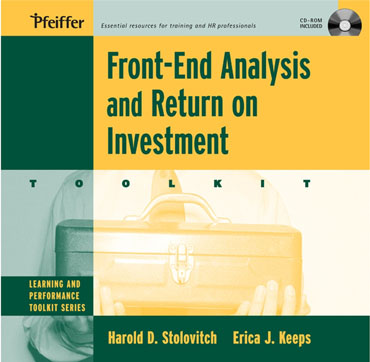
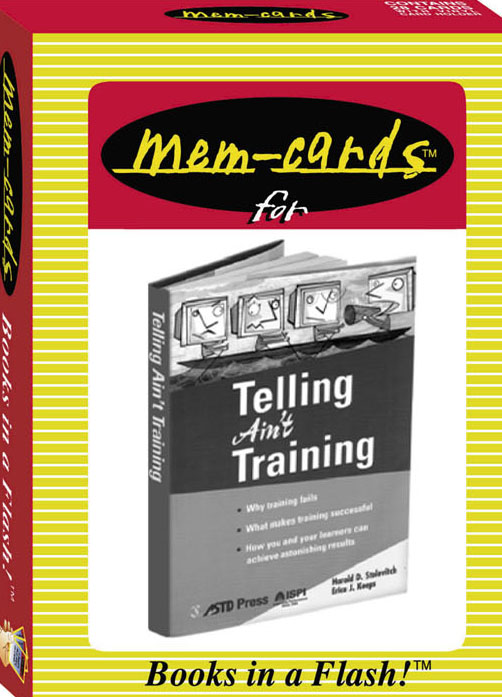
Click on any of the covers below for more information or to purchase copies of our books and learning aids.

For more information on HSA, visit our Website
at www.hsa-lps.com, email us at info@hsa-lps.com
or call us toll free at 1-888-834-9928.If you have any questions or comments, please feel free to contact Samantha Greenhill, Publications and Communications Specialist, at sgreenhill@hsa-lps.com.

To unsubscribe from this Newswire, please reply to this email and put the word UNSUBSCRIBE in the subject line.
© Copyright 2009 Harold D. Stolovitch & Erica J. Keeps