
By Harold D. Stolovitch, PhD, CPT, and Erica J. Keeps, CPT
hstolovitch@hsa-lps.com & ekeeps@hsa-lps.com
In this series of articles, we address whole learning systems, some of which are rarely used although they have demonstrated effectiveness. We're not certain why some beneficial systems aren't used more frequently, but our experience tells us that many people in the learning and performance world either don't know about them, don't know how to develop and implement them, or simply are fearful of rocking the boat.
We continue to address these learning systems (natural experience, experimental learning, structured on-the-job training [SOJT], learner controlled instruction [LCI] and individual developmental plans) which have stood the test of time and have demonstrated effectiveness in this edition of the HSA e-xpress. For each of these learning systems models, we have created an information chart that can familiarize you with them and help you try them out. In the July 2010 edition of the HSA e-xpress, we presented natural experience (click here to read it). In this edition, we offer experiential learning.
Experiential Learning
What is it?
- This is a method or system for building learning through doing and reflection.
- Experiential learning is very similar to natural experience. However, the individual or group also participates in structured debriefing sessions.
- Not only do learners experience either the real thing or a psychologically realistic simulation, but they then reflect on the experience encountered in a structured manner, drawing conclusions or planning new courses of action.
With whom can it be used?
- Although it can be used with any learner, including young children, it is best applied in the workplace with learners who have not experienced certain events or situations, but require such experience to better perform in their jobs (for example, new supervisors, managers who will be negotiating contracts, new instructors).
- People who know the theory of complex interactions (physical, social or social-physical) but have never experienced the real thing can benefit from this system of learning.
For what type of content can it be used?
- It is most suited for content that involves complex interactions - mostly of a social nature (although operating equipment in an emergency context would also qualify).
- Defined content is best. Unlike natural experience in which the learner may encounter a variety of events, sometimes in random fashion, experiential learning usually works best with specified content (for example, handling an awkward negotiation or experiencing how it feels to be a disabled person traveling on a subway).
- This works well for content that fits into a professional course of study (for example, an internship or structured practicum in a hospital for a social worker) and requires real or realistic activity as well as structured reflection.
What are the components?
- Essentially there are two main components: the experiential activity and the structured debriefing.
- The experiential activity is one that is planned and designed to enable learners to engage in real-world or real-world-like situations. It can be of any duration, but usually has a defined time limit. During the activity the person gets to do what is required in real life and to feel the same emotions that the real thing would generate (for example, going to a subway station in a wheelchair and navigating from a starting point to a distant destination; preparing and delivering a lesson on a specified content topic to a group of learners).
- The structured debriefing and reflection phase is conducted by a trained and proficient facilitator who elicits from the learner what occurred, why events transpired, what the implications are, how this affects performers and performance in the real world, what conclusions can be drawn, and what changes or actions the learner will take going forward.
- Other components include journals, printed questions for reflection and equipment/materials that are typically required for the activity.
How does it work?
- Generally a job or work analysis is conducted to determine those experiences that are essential to a person's functioning well in the job. Examples of these might be counseling a poor performer, hiring the right person for a key job, presenting the organization's position at a press conference or making critical decisions and resolving issues under high pressure or emergency conditions.
- For each identified experience, a situation is designed or identified in the real-world context.
- The learner is placed in the activity and acts naturally.
- There may be a number of activities of variable lengths and conditions, depending on the nature of the job and/or expectation.
- At the conclusion of the activity, the learner is drawn through a structured debriefing designed to help build her or his understanding of what occurred during the activity and what courses of action are best suited to the circumstances.
- The learner draws conclusions about his or her experiences, makes decisions about future conduct and either continues with new experiential activities or repeats the experience for practice and additional insights.
What are the advantages?
- Compared to natural experience, the main advantages of experimental learning are shorter time requirements for each activity; greater control over process and outcomes; lower risk/threat; guided discussion and reflection on experiences including drawing out of principles and conclusions; and ability to re-experience under controlled conditions.
- Compared with more traditional learning systems, experiential learning requires actual doing under real or realistic conditions. The affective dimension is much greater than in conventional systems. Reflection and conclusions are based on actual rather than imagined experience.
- Learning can build through a series of experiences and structured thought.
- The system is a highly engaging approach to learning and, when integrated with other systems, adds depth to the learning process.
What are the disadvantages?
- Experiential learning is not as "real" as natural experience. It's more deliberate and thought out.
- Experiential learning consumes time and resources.
- This is not a strong method for acquiring technical or other forms of declarative knowledge.
- As with natural experience, despite structured debriefings, there is some uncertainty with respect to learning outcomes.
What resources are required?
- Personnel:
- an instructional designer to identify appropriate experiences and design the activities and debriefings
- a content/subject matter expert to ensure that the activities are valid and authentic
- an expert facilitator for the structured reflection-debriefing (this person also may be the content expert).
- Time:
- experiential activities development time
- administrative time to organize activities
- subject matter expert and facilitator time to validate the activities and develop the debriefing questions
- learner time
- debriefing time.
- Costs:
- activity and debriefing development costs
- personnel costs for administrating and monitoring experiential learning activities.
What are some examples?
- Structured practica with debriefing sessions
- Structured and mentored internships
- Field placement with coaching
- On-the-job practice and work sessions with debriefings
- Supervised transitional work settings following training
- Practice teaching with observation/recording and debriefing.
Be sure to catch the third learning systems model - Structured On-the-Job Training - in the January 2011 edition of the HSA e-Xpress.
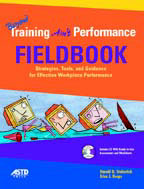
This article is an excerpt from Harold Stolovitch and Erica Keeps' bestseller,
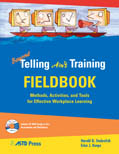
Beyond Training Ain't Performance Fieldbook.
Interested in learning more? Click here
to order a copy of the book.

 Talent
Management is a monthly magazine directed to top-level management,
senior human resources and workforce and organizational development executives
whose task is to optimize the abilities of their human assets to drive
and improve the execution of enterprise strategy.
Talent
Management is a monthly magazine directed to top-level management,
senior human resources and workforce and organizational development executives
whose task is to optimize the abilities of their human assets to drive
and improve the execution of enterprise strategy.
Harold Stolovitch is the "Human Performance" columnist for Talent Management magazine. You can read his latest article, "Driving High Performance" by visiting page 12 of the October 2010 digtial edition at http://www.nxtbook.com/nxtbooks/mediatec/tm1010/#/14. For more information on Talent Management, visit their Website at www.talentmgt.com.

 Dr.
Harold Stolovitch, Emeritus professor, Human Performance at Work and Principal
of HSA Learning & Performance Solutions, has successfully developed
workplace learning and performance professionals for over 40 years. He
is an experienced keynote speaker, workshop leader, author and consultant
who has worked with hundreds of major corporations and professional organizations
throughout the world.
Dr.
Harold Stolovitch, Emeritus professor, Human Performance at Work and Principal
of HSA Learning & Performance Solutions, has successfully developed
workplace learning and performance professionals for over 40 years. He
is an experienced keynote speaker, workshop leader, author and consultant
who has worked with hundreds of major corporations and professional organizations
throughout the world.
Harold is available for presentations, keynote addresses, consulting and workshops at corporations and professional organizations. Click here for more information.

 For
years, employers and clients have been asking for standards and criteria
to help them distinguish practitioners who have proven they can produce
results through a systematic process. Until the development of the Certified
Performance Technologist (CPT) designation, anyone could claim that they
are professionals in performance improvement and training. At the same
time, practitioners have been asking for a credential that would help
them assess their ability, better focus their professional development
efforts and recognize their capability. In response to this need, the
International Society for Performance Improvement (ISPI) developed a program
through which individuals can apply to receive the designation of CPT.
For
years, employers and clients have been asking for standards and criteria
to help them distinguish practitioners who have proven they can produce
results through a systematic process. Until the development of the Certified
Performance Technologist (CPT) designation, anyone could claim that they
are professionals in performance improvement and training. At the same
time, practitioners have been asking for a credential that would help
them assess their ability, better focus their professional development
efforts and recognize their capability. In response to this need, the
International Society for Performance Improvement (ISPI) developed a program
through which individuals can apply to receive the designation of CPT.
The eligibility requirements to apply for certification include a minimum of three years of experience in performance improvement or a related field and a detailed description of work performed in multiple projects in a manner that demonstrates the use of each of the Standards with attestations from internal/external clients or supervisors. A qualified reviewer will review all the documentation received from a candidate and determine if all requirements have been met.
All candidates for the certification must commit to the Code of Ethics. Membership in ISPI or any other organization, or the completion of a formal training or education program is not required for certification.
For more information on ISPI's CPT program, visit their Website at http://www.ispi.org/content.aspx?id=186.

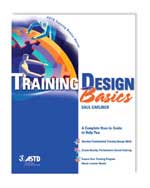 Our
Guest Author Series features articles by various professional colleagues.
The latest in our series is an excerpt from Training
Design Basics by Dr. Saul Carliner, CPT. Dr. Carliner is an associate
professor with a graduate program in educational technology at Concordia
University in Montreal, Canada specializing in the design of learning
and communication materials for the workplace, and the management of groups
that create these materials. He can be reached at saul.carliner@education.concordia.ca.
Our
Guest Author Series features articles by various professional colleagues.
The latest in our series is an excerpt from Training
Design Basics by Dr. Saul Carliner, CPT. Dr. Carliner is an associate
professor with a graduate program in educational technology at Concordia
University in Montreal, Canada specializing in the design of learning
and communication materials for the workplace, and the management of groups
that create these materials. He can be reached at saul.carliner@education.concordia.ca.
What Is Formative Evaluation?
By Dr. Saul Carliner, CPT
One of the key challenges of preparing a training course is making sure that it will really accomplish the objectives for which you developed it. The only way to know with any certainty is to assess the course as you develop it.
Assessing the effectiveness of a course while it is under development is called formative evaluation, because you assess the course while you it is under form-ation. Formative evaluation contrasts with summative evaluation, which assesses the effectiveness of a course that is generally available (for example, a classroom course that is listed in a course catalog and available for enrollment, or a workbook that learners can order and use now). Kirkpatrick's four levels of evaluation are examples of summative evaluation.
Because you conduct a formative evaluation while the course is under development, its only purpose is improving the course and increasing the likelihood that the course will achieve its objectives when you make it generally available. Rather than report the results externally, the team developing the course uses this information to revise the course and make it more effective.
Specifically, during formative evaluation, you try to make sure that the course has these qualities:
- Understandable. Learners should comprehend content on the first explanation, and follow exercises with no additional assistance, other than that provided in the instructions. Learners not be slowed by inconsistencies in content and terminology, grammatical errors, and awkwardly presented content.
- Accurate. The material should be current and correct.
- Working. Printed pages should match those on the screen in word processors. Slides should appear on the projector as they do on the computer screen. Addresses of websites shown to class should be accurate. On-screen exercises should work as intended (for example, sample files and programs should be installed and working).
To address these issues, you conduct three types of formative evaluations:
- Pilot tests.
- Technical reviews.
- Production reviews.
The following sections describe each of these types of reviews.
Pilot Tests
A pilot test is one in which you conduct the course for the first time with people who represent the intended learners for the purpose of assessing which parts work and which ones need improvement. For those parts of the course that need improvement, you try to pinpoint the specific improvements that you need to make.
A pilot test tests the course, not the learners. That is, the results are intended to assess whether or not the course works, even test results. Because the course has not been proven to be effective yet, you do not use the test results to assess the success of learners. You might find errors in the teaching sequence or in the wording of test questions, which limit the ability of learners to pass the course.
Trainers generally conduct a pilot test with the second draft of course materials.
Technical Reviews
In a technical review, subject matter experts verify the accuracy of the content. Technical reviews are especially important because incorrect technical information poses a potential liability.
- In regulated industries, such as the pharmaceutical industry, incorrect content could cause learners to perform their jobs incorrectly, and that could create a life-threatening situation (such as doctor prescribing the wrong medicine).
- With new products that are not yet complete while you develop the course (this is especially true with software), the learning program could provide incorrect instructions or refer to material that has significantly changed, causing frustration and other potential problems for learners.
- For content that has high visibility or sensitivity within an organization, such as management training, the content presented must represent a consensus. Otherwise, learners might follow policies and approaches on the job that key decision makers do not support.
During a review, designated people read through the draft of a course and assess its effectiveness according to a certain set of criteria. The criteria vary, depending on the reviewer's perspective and expertise. For example, a subject matter expert might review a draft to assess whether the technical content is accurate. A marketing specialist might review a draft to assess whether the course is going to reach the intended audience. And a sponsor might review a draft to assess whether the intended users will be able to achieve the intended objectives with the course.
During a technical review, several subject matter experts simultaneously review the draft.
Production Reviews
In a production review, editors assess the completeness and style of the content, and production specialists make sure that the printed and projected output matches that which appears on the computer screen.
An editor serves as the "first reader" of a communication product. As the first reader, the editor addresses a wide range of issues that, if not addressed, could cause problems-like a glaring misspelling on a slide.
One of the best known issues is mechanics: grammar, usage, spelling, punctuation, and other mechanical aspects of text. This task of making sure that copy is grammatically and stylistically correct is called copyediting. Copyediting specifically looks at issues like these:
- Issues of editorial
style, including:
- Usage
- Spelling
- Punctuation
- Capitalization
- Consistency of terminology
- Parallelism and levels of headings (that is, did you designate a heading at the appropriate level)
- Issues pertaining
to the layout of slides and pages: makes sure that designs of one slide
or page is consistent with others in the slide package or student materials.
More specifically, editors make sure that:
- Templates for
screens and pages are appropriately followed.
Headings are at the appropriate level and consistently used from screen to screen and page to page. - Tables and charts, are consistent in appearance and style. For example, if a table in topic 4 has lines separating the cells and the column heading for it are initial capped, the copyeditor makes sure that the chart in topic 14 follows the same instructions.
- Illustrations and graphics are properly placed. The editor also makes sure that each graphic has a caption and, if used a figure number (if you are using figure numbers).
- Margins are clearly marked and observed
- Type fonts are consistent and properly used, especially emphasis type (such as bold and italic). For example, terms from other languages that appear in English documents are usually italicized.
- Templates for
screens and pages are appropriately followed.
Editors also serve a more substantive role, working closely with course developers to fortify the structure of their courses, to identify and resolve unclear passages, and to enhance the presentation of information so that users can easily understand it. This communication coaching is called substantive editing, and is one of the key benefits that an editor brings to the course.
Because many training organizations do not have editors on staff, course designers and developers perform editorial duties when reviewing one another's courses. This is called peer editing, because peers (co-workers) perform the editing.
If your organization does provide access to editors, definitely seek out a peer edit. Because you have such a close relationship to the course, you often cannot see some of the most glaring typographical and stylistic errors. A second set of eyes is helpful.
Furthermore, if a peer is only available to review the course once, schedule that review for the last draft, to ensure that the final product is free of mechanical, stylistic, and visual errors.

 Here's
where Harold Stolovitch will be presenting in the near future:
Here's
where Harold Stolovitch will be presenting in the near future:
EK, is there anything to include here or should I remove this feature for this edition?
Click here to view HSA's Events Calendar to learn where and when Harold will be speaking as well as to read session descriptions.

 Do
you have any burning Human Performance Technology questions? Visit the
Ask Harold section of HSA's Website
and ask your questions for Harold Stolovitch to answer. Here is a recent
submission:
Do
you have any burning Human Performance Technology questions? Visit the
Ask Harold section of HSA's Website
and ask your questions for Harold Stolovitch to answer. Here is a recent
submission:
I
have to do a presentation for our Organizational Development team on publicity
writing and marketing OD programs. Can you give me some resources to use?
To read
the response, visit Ask
Harold. To ask your own question, just click on the crystal
ball at left, fill out the form and click on submit.

Click on any of the covers below for more information or to purchase copies of our books and learning aids.




For more information on HSA, visit our Website
at www.hsa-lps.com, email us at info@hsa-lps.com
or call us toll free at 1-888-834-9928.If you have any questions or comments, please feel free to contact Samantha Greenhill, Publications and Communications Specialist, at sgreenhill@hsa-lps.com.

© Copyright 2010 Harold D. Stolovitch & Erica J. Keeps